
An AI agent merges a pull request while your team sleeps. The tests pass, the preview looks healthy, and the deployment reaches production without a human touching it. The next morning, someone asks a reasonable question: what exactly happened, and can we prove it?
That question becomes difficult when the answer is spread across a model provider, a CI system, a cloud region, an agent runtime, and several application logs. Compliance automation closes that gap by making controls part of the infrastructure that runs the agent, not a report assembled after the fact.
Table of Contents
<a id="the-2-am-moment-every-ai-team-eventually-faces"></a>
The 2 A.M. Moment Every AI Team Eventually Faces
At 2 a.m., an autonomous coding agent notices a failing test, edits the repository, opens a pull request, and merges it after the checks pass. A deployment follows automatically. Nobody is watching the terminal, reviewing each tool call, or checking which context the agent retrieved before it changed the code.
At 9 a.m., the on-call engineer sees a successful release. What they don't see immediately is just as important. The record doesn't clearly show which model generated the code, which identity or API key paid for inference, where intermediate prompts were stored, or whether personal information crossed a regional boundary during the run.
The deployment worked. The audit trail didn't.
Practical rule: Treat every autonomous action as an event that must be reconstructable, not merely an outcome that must be observable.
This is the operational definition of the compliance problem for AI agents. A failure doesn't always look like a breach, an outage, or an obvious policy violation. It can look like productive work that nobody can explain later. An agent may complete a valid task while using an unapproved model endpoint, retaining sensitive context longer than intended, or moving data through a region the organization has restricted.
The engineer then starts reconstructing the run manually. They search CI logs, model-provider consoles, shell history, application traces, and cloud storage. If those systems use different identities, retention settings, and timestamps, the investigation becomes an exercise in approximation.
Compliance automation exists to prevent that reconstruction exercise. Audit logs answer what happened. Regional controls answer where it happened. Key governance answers which credentials were used. Policy enforcement answers whether the action was allowed. Evidence collection then preserves the decision in a form an operator, security team, or auditor can inspect.
The goal isn't to make agents less useful. It's to ensure that an agent can move quickly without becoming invisible. A hosted AI stack needs controls at the same places where the agent deploys, calls models, accesses memory, invokes tools, and stores results.
<a id="what-compliance-automation-means"></a>
What Compliance Automation Means
At 2 A.M., an agent deploys a new version and starts calling a model endpoint. The team later discovers that the workload used the wrong region, retained sensitive context too long, or bypassed an approval rule. A policy document may describe the correct behavior, but the hosted runtime still needs a way to evaluate and enforce it during the action.
A useful analogy comes from the system itself. A thermostat reads the current temperature, compares it with a setpoint, and triggers a response when the values differ. The rule is wired into the equipment that does the work, rather than stored only in a document. Compliance automation applies the same principle to an AI stack.
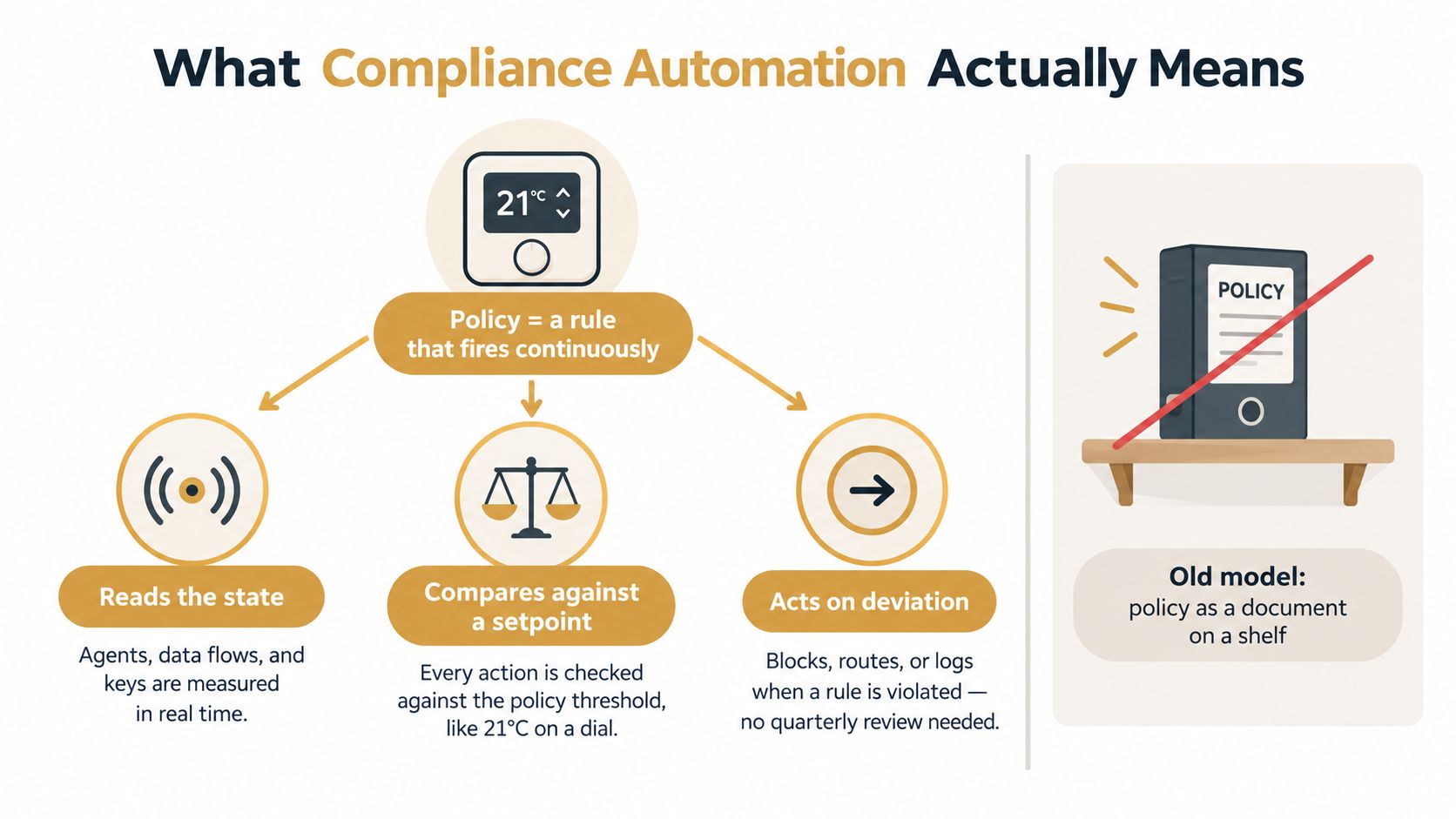
Policy-as-code expresses a requirement in a machine-evaluable form. In a hosted AI runtime, a rule can check who is deploying, which model key is being used, where data may be processed, which tools an agent may call, and what evidence must be recorded. A team can version and test those rules alongside application code.
<a id="from-documents-to-decisions"></a>
From documents to decisions
A practical compliance rule might require the following:
A production agent may call only an approved model endpoint.
Sensitive workloads must use an allowed region, such as an EU-resident environment.
A deployment that changes a permission boundary requires human approval.
Every model call must produce a timestamped event.
Shared memory must be isolated by tenant and governed by retention settings.
Each rule needs an enforcement point. That point could be a deployment gateway, runtime proxy, identity service, storage layer, or CI/CD step. The system can then allow, deny, route, or record the action, while audit logs preserve the relevant identity, endpoint, region, decision, and deployment context. Bring-your-own model keys also need governance, so the runtime can associate a call with the credential used without exposing the secret itself.
Periodic compliance examines past activity and asks whether the available evidence is sufficient. Continuous compliance evaluates the current state as an action occurs. A periodic audit may find configuration drift after an agent has deployed. A runtime check can block or record that drift at the point of change.
Checks can run on every commit, pull request, deployment, or model invocation. Research on continuous compliance describes this move from periodic sampling to deterministic control checking, with the evaluated input, policy decision, and evidence captured as part of the event record in research on continuous compliance verification.
<a id="why-agents-make-the-difference"></a>
Why agents make the difference
A human developer usually recognizes a privileged change while making it. An autonomous agent can perform several actions in sequence without a person watching. It may read a repository, retrieve memory, call a model, invoke a tool, alter configuration, and deploy a branch.
That sequence creates multiple enforcement points. A control that runs only during a quarterly review cannot constrain an action completed minutes earlier. A control embedded in the agent loop can evaluate each step and create an audit trail that explains what happened.
Enterprise behavior reflects this shift. The 2025 PwC Global Compliance Survey found that 49% of respondents were already using technology for 11 or more compliance activities, while 82% planned to invest more in at least one technology for compliance automation. AI teams should expect compliance workflows to operate inside deployment, inference, identity, and storage systems rather than beside them.
Market forecasts point in the same direction. Stratistics MRC estimated the Compliance Automation and Regulatory Reporting market at $10.8 billion in 2026, projecting $39.1 billion by 2034 at a 17.4% CAGR, as reported in this compliance automation market forecast. Compliance automation is becoming an infrastructure layer for governed AI operations, not merely a reporting function.
<a id="six-building-blocks-every-ai-deployment-needs"></a>
Six Building Blocks Every AI Deployment Needs
A governable AI deployment is a loop made from six connected building blocks. Each one solves a different problem, and each one fails if the surrounding pieces aren't present.
<a id="policy-as-code-needs-enforcement"></a>
Policy-as-code needs enforcement
Policy-as-code expresses rules in a versioned, testable form. It can specify which identities may deploy, which regions are permitted, and which tools an agent may invoke. But a policy sitting in a repository doesn't stop anything unless the runtime, pipeline, or gateway evaluates it.
The control should produce a decision and preserve the inputs behind that decision. That makes the policy itself inspectable and lets a team review changes through normal software practices.
<a id="audit-logs-need-ownership"></a>
Audit logs need ownership
Audit logs should record model calls, prompt and tool events where appropriate, identity, endpoint, region, policy result, and deployment context. They must also be queryable and protected against inappropriate alteration.
A log without a retention owner becomes clutter. A log without residency controls may create the very data-transfer issue it was meant to document. Teams should decide what gets captured, how sensitive content is handled, who can read it, and how long each class of evidence is retained.
<a id="data-residency-needs-an-egress-view"></a>
Data residency needs an egress view
Regional pinning is more than selecting a location for a primary database. Teams need to examine storage, shared memory, inference, backups, observability systems, support access, and external integrations.
An EU region can still leak data through an unexamined model endpoint or telemetry pipeline. Residency therefore needs to be enforced across the whole path, not asserted by the location of one service.
<a id="model-keys-need-separation"></a>
Model keys need separation
Bring-your-own-key arrangements separate the customer's inference identity from the platform's billing identity. That separation helps the customer control provider access, rotate credentials, and attribute usage to the right tenant or workload.
It doesn't make key management safe by itself. Keys must never be placed in prompts, committed to repositories, or exposed to an agent with broader permissions than it needs. The runtime should inject credentials through scoped mechanisms and make revocation possible without rebuilding the agent.
<a id="control-mapping-needs-evidence"></a>
Control mapping needs evidence
Technical events become useful for an audit only after someone maps them to a control or requirement. A deployment decision, for example, can support an access-control narrative when the evidence includes the actor, policy version, target environment, decision, and timestamp.
Policy-as-code systems improve this process by turning operational signals into machine-readable records that can be connected to frameworks such as SOC 2, ISO 27001, PCI-DSS, NIST 800-53, or GDPR technical controls, as described in Red Hat's explanation of policy-as-code enforcement.
<a id="integration-surfaces-complete-the-loop"></a>
Integration surfaces complete the loop
APIs and webhooks let compliance state reach the systems people already operate. A blocked deployment can create a ticket. A key event can reach a SIEM. An identity change can trigger de-provisioning. An auditor can query evidence without asking an engineer to collect screenshots.
Fine-grained permissions matter here. Teams evaluating access design can use Sokko's guide to access-control granularity when deciding which identities should see logs, memory, deployment controls, or credential operations.
| Building Block | What It Does | Fails When Used Alone |
|---|---|---|
| Policy-as-code | Encodes rules that systems can evaluate | No enforcement point means no control |
| Audit logs | Records actions and decisions | Undefined retention or residency reduces their value |
| Data residency | Restricts where data is processed and stored | Unchecked egress can bypass the regional boundary |
| Model key handling | Separates customer credentials from platform access | Exposed keys can outlive the policy that should revoke them |
| Control mapping | Connects events to audit requirements | A framework label without evidence is only a claim |
| Integration surfaces | Sends state to identity, SIEM, and ticketing tools | Isolated evidence creates another manual queue |
<a id="how-sokko-wires-compliance-into-the-agent-loop"></a>
How Sokko Wires Compliance Into the Agent Loop
A hosted runtime can turn these blocks into behavior by deciding important properties before the first prompt runs. In Sokko's model, teams choose a US or EU hosting region, with EU data residency options for storage, shared memory, and model inference. That makes location a provisioning decision rather than a remediation task after data has already moved.
<a id="start-with-the-execution-boundary"></a>
Start with the execution boundary
A devbox runs a repository's application stack on an isolated cloud machine and exposes a branch through a preview URL. That boundary gives the agent a concrete execution target, while the platform can associate the run with an organization, a repository, a region, and a lifecycle.
The useful compliance property isn't the preview URL alone. It's the context around it. A reproducible preview can carry the identity and configuration required to explain which branch ran, which environment it touched, and which agent initiated the deployment.
Teams evaluating this pattern can compare it with the broader capabilities of an AI agent deployment platform, especially when agents need both hosted execution and visible previews.
<a id="keep-memory-inside-the-tenant-boundary"></a>
Keep memory inside the tenant boundary
Persistent shared memory creates a second control surface. Agents can write decisions, preferences, and operational context that later agents retrieve. Without tenant scoping and deliberate retention, that memory can become an uncontrolled data store.
The platform's shared-memory option is designed for agents that need persistent context across runs. Teams still need to define what may enter memory, who can retrieve it, and when content must be removed. A compliance design should treat memory retrieval as a data-access event, not as an invisible convenience feature.
<a id="make-operations-inspectable"></a>
Make operations inspectable
A live terminal and log access give operators a read-only path into what an agent is doing and what its hosted environment reports. That supports investigation without requiring direct server access or a separate local setup.
The evidence should answer practical questions:
Identity: Which organization, agent, or operator initiated the event?
Target: Which repository, devbox, endpoint, or model was involved?
Location: Which hosting and inference region handled the data?
Decision: Which policy allowed, denied, or routed the action?
Outcome: What happened after the decision, and where is the resulting log?
<a id="keep-credentials-under-customer-control"></a>
Keep credentials under customer control
Bring-your-own model keys let customers use their own credentials for providers such as Claude, GPT, Gemini, or local endpoints. This creates a clearer ownership boundary, but the team must still protect the secret, scope its use, and rotate it through an operational process.
The runtime should ensure that a key isn't copied into prompts or repository files. Revocation must also be connected to identity and policy state. If a workload is no longer authorized, its model credential should not remain usable just because the agent process is still running.
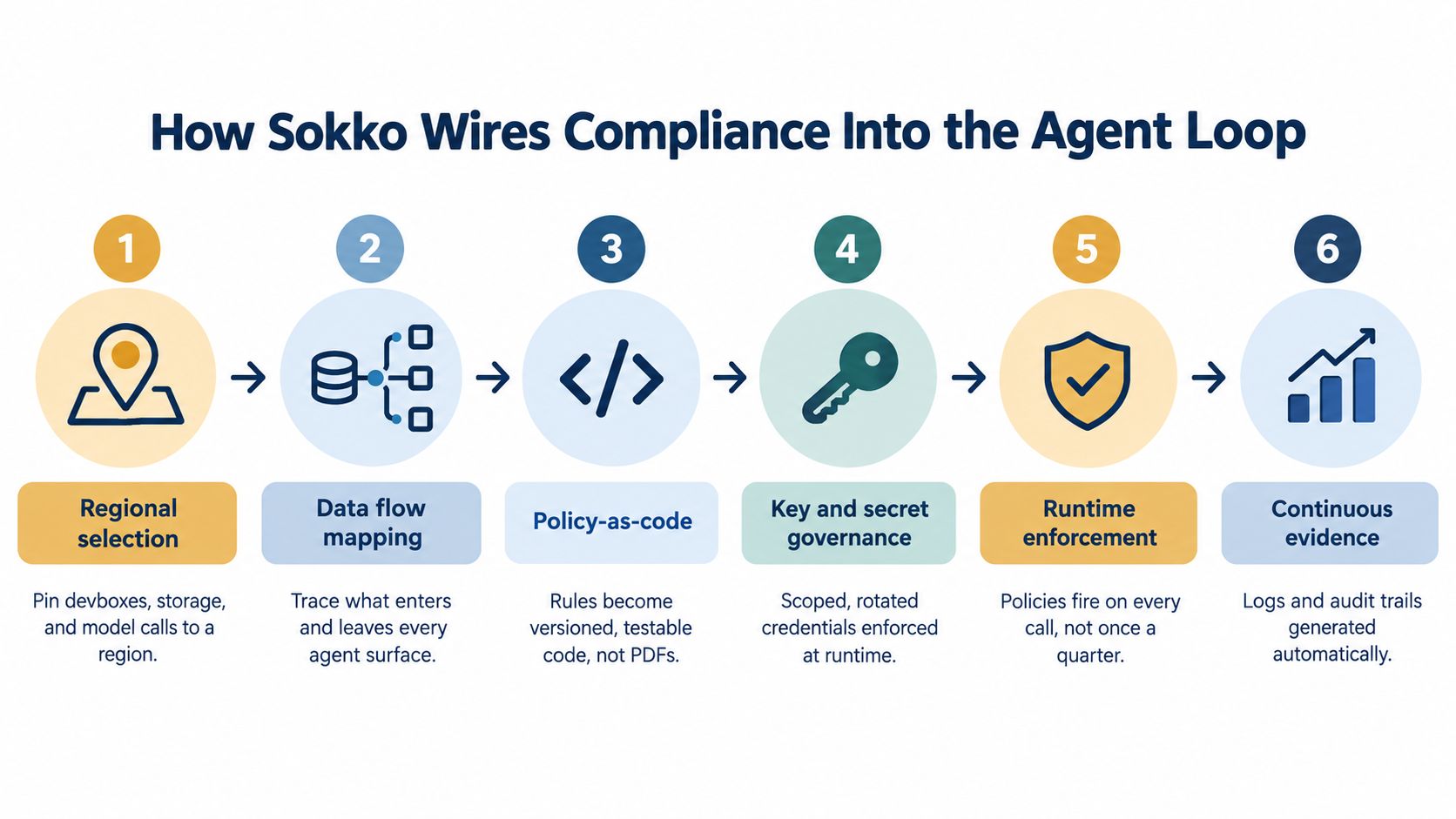
The resulting pattern is a loop: select the region, identify the data flow, evaluate policy, govern the key, enforce the decision, and preserve the evidence. The same loop can support a coding agent deploying a preview and an operations agent responding through a connected workplace application.
<iframe width="100%" style="aspect-ratio: 16 / 9;" src="https://www.youtube.com/embed/dzYH0OLSybg" frameborder="0" allow="autoplay; encrypted-media" allowfullscreen></iframe><a id="mapping-these-controls-to-soc-2-and-gdpr"></a>
Mapping These Controls to SOC 2 and GDPR
Technical controls become useful to buyers when they translate into evidence. SOC 2 and GDPR ask different questions, but the same runtime events can often support both.
SOC 2 generally focuses on whether controls exist, are designed appropriately, and operate consistently over time. GDPR focuses on lawful and controlled processing of personal data, including enforceable rights and appropriate safeguards for transfers. Neither framework is satisfied by a dashboard screenshot that cannot be reproduced.
<a id="use-one-event-stream-for-two-questions"></a>
Use one event stream for two questions
A deployment policy decision can demonstrate that access was evaluated and enforced. A regional inference record can help show where processing occurred. A memory retrieval event can show how a tenant boundary was applied. A key-rotation event can document credential lifecycle activity.
The mapping should preserve the original evidence, not just a compliance label. For each event, retain the policy version, relevant identity, input state, result, and timestamp. That gives an auditor or privacy reviewer a path back to the actual technical action.
For GDPR, teams should also connect technical controls to processing records and data-subject workflows. A log may show that a request was received, but the organization still needs a controlled process for locating, reviewing, exporting, or deleting the relevant personal data.
| Sokko Control | SOC 2 Criterion | GDPR Article |
|---|---|---|
| Policy evaluation for deployments and access | CC6 logical access | Article 25, data protection by design |
| Runtime and terminal audit records | CC7 system operations | Article 30, records of processing |
| Regional hosting and inference selection | CC9 risk mitigation | Article 44, transfer requirements |
| Scoped model credentials and rotation | CC6.1 credential lifecycle | Article 28, processor obligations |
| Tenant-scoped shared memory | Access and change-control evidence | Article 25 and Article 17 operational support |
| Exportable evidence and integrations | Monitoring and audit support | Accountability and documented processing |
The comparison is useful because it prevents a common mistake. A team may satisfy an access-control review while failing to answer where personal data went. Conversely, it may document a regional boundary without proving that the agent's identity was authorized to use the data.
A practical implementation should map each control to both its technical enforcement point and its evidence destination. Sokko's overview of EU GDPR requirements is a useful starting point for teams translating regional and privacy requirements into platform decisions.
The strongest evidence isn't a polished report. It's a reproducible chain from request, to policy evaluation, to system action, to retained record.
<a id="the-trust-gap-nobody-talks-about"></a>
The Trust Gap Nobody Talks About
Compliance automation can produce more activity without producing more confidence. A platform may generate logs, scans, alerts, and attestations while leaving a regulated buyer unable to verify the decision that matters.
That is why buyers often challenge automation claims that focus only on speed. They want to know whether the output is trustworthy enough to support a release decision, a privacy response, or a regulator conversation.
<a id="validation-comes-first"></a>
Validation comes first
A human reviewer should be able to replay an agent's decision path from durable artifacts. The record should identify the input, actor, policy version, environment, model or tool endpoint, result, and any approval that changed the outcome.
If the only explanation is a vendor-controlled dashboard, the evidence is difficult to challenge and difficult to migrate. Exportable, structured records give the customer a way to inspect the system independently.
<a id="explainability-must-serve-two-audiences"></a>
Explainability must serve two audiences
Engineers need precise fields and event relationships. Auditors and privacy teams need a readable explanation of why the system allowed or blocked an action. A useful policy result should expose the rule, the evaluated input, the actor, and the decision without requiring someone to interpret raw infrastructure traces.
This doesn't mean every model response must be perfectly interpretable. It means the surrounding control decision must be explainable. Teams can often govern a model call more effectively by recording endpoint, identity, region, data class, and policy result than by pretending the model's internal reasoning is an audit artifact.
<a id="high-risk-actions-need-a-person"></a>
High-risk actions need a person
Automation should orchestrate human review when the consequence is difficult to reverse. Examples include rotating a production model credential, permitting a cross-region transfer, or executing a deletion request under GDPR Article 17.
A good gate doesn't turn every event into a manual approval. It separates routine, low-risk actions from decisions that require judgment. The 2025 Regology regulatory compliance survey reported that 71.1% of professionals saw potential for AI in compliance while also highlighting concerns about bias, privacy, and accuracy. That tension explains why validation and review thresholds matter.
The operational test is simple. Does the evidence stream shorten real audit preparation and incident investigation, or does it create dashboards nobody opens? If operators can't use the records to make a decision, the automation is generating noise.
<a id="a-working-adoption-checklist-for-2026"></a>
A Working Adoption Checklist for 2026
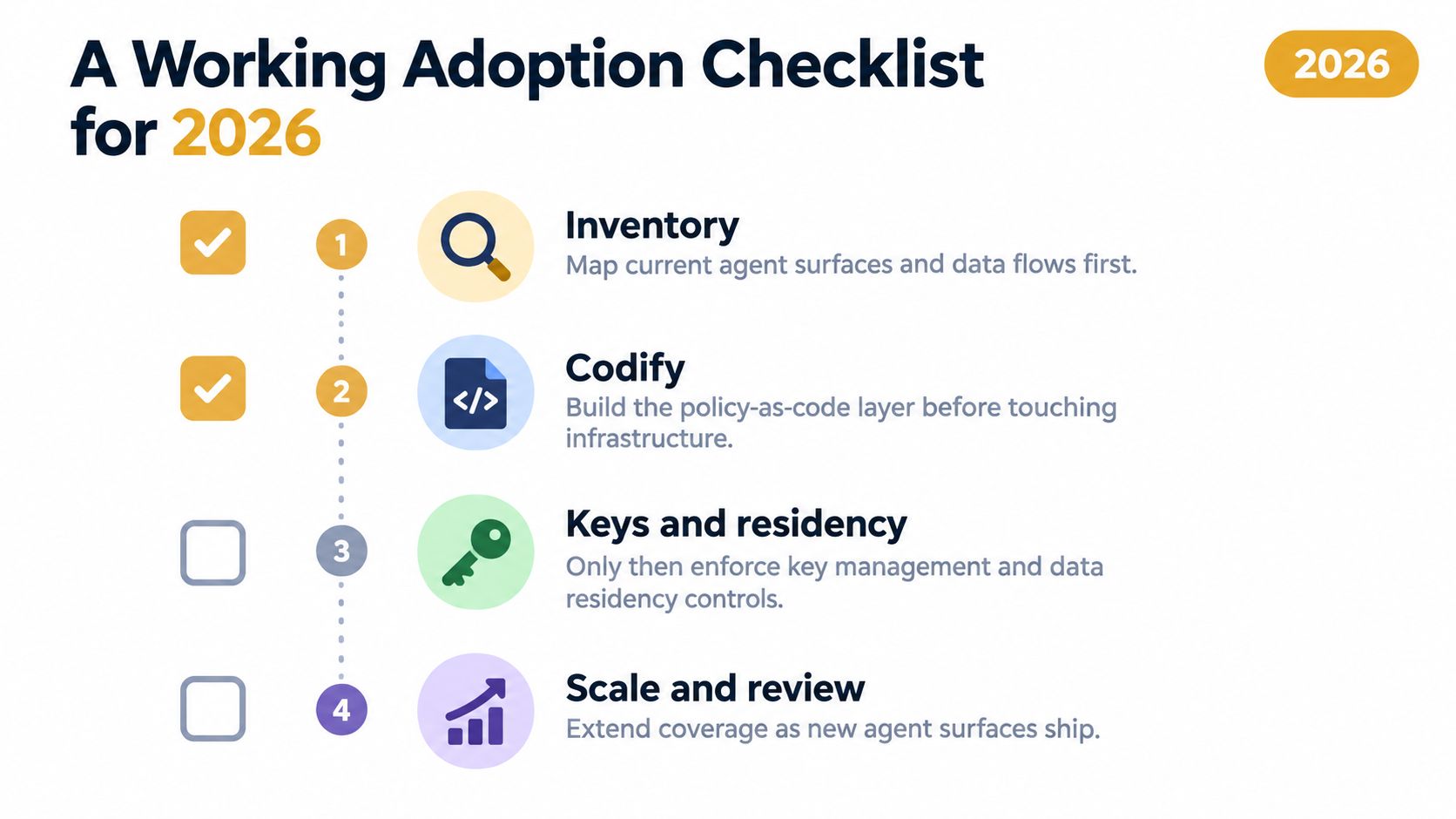
Start with the surfaces you already run. Inventory agents, repositories, model endpoints, connected applications, memory stores, deployment paths, and the data each one handles.
Then sequence the controls:
Inventory: Map agent actions and data flows before selecting enforcement points.
Codify: Write the rules in versioned policy-as-code and test them against representative actions.
Keys and residency: Enforce credential ownership, approved endpoints, and regional boundaries after the policy layer is clear.
Scale and review: Add audit ownership, evidence exports, SIEM or ticketing integrations, and human gates for high-risk actions.
Avoid collecting every possible prompt and event before deciding retention and access rules. Don't map controls to SOC 2 before a continuous check runs, and don't treat GDPR consent or deletion workflows as separate from agent memory and retrieval design.
The stack is working when audit queries return quickly, policy violations block deployments rather than appearing after release, key rotations complete without downtime, and regional traffic stays inside the chosen jurisdiction. Weak automation produces alerts that nobody triages. Useful automation produces audit-ready evidence and fewer review bottlenecks.
Sokko provides hosted AI-agent runtimes, isolated devboxes, EU-region hosting options, shared memory, live operational access, audit logs, and bring-your-own model keys for teams building governed agent workflows. Visit Sokko to evaluate how your agents can deploy, run, and generate evidence inside the same infrastructure loop.