
Your platform team deploys an always-on AI agent in Frankfurt. The agent records user prompts, writes embeddings into shared vector memory, and sends inference requests to a third-party model endpoint in the United States. Within days, someone notices that prompts contain names and email addresses, the vector store has no deletion policy, and the processor agreement says nothing about inference.
That deployment isn't unusual. The mistake is treating EU GDPR requirements as a privacy-notice exercise instead of an engineering operating model. GDPR applies to the data flowing through the runtime, the memory layer, observability systems, subprocessors, backups, and model endpoints.
The practical question is not whether your agent has a consent banner. It's whether your team can identify the lawful basis for each flow, prove who controls the data, enforce residency and retention choices, fulfill rights requests, and produce DPIA evidence under pressure. The architecture decisions behind AI agent hosting determine whether that evidence exists.
Table of Contents
Why EU GDPR Requirements Matter for Hosted AI Agents
The Frankfurt deployment fails before anyone writes a policy because the team hasn't mapped the data lifecycle. A prompt enters through Slack or a web interface, the agent adds it to a trace, an embedding service transforms it, shared memory stores the representation, and a model provider receives an outbound payload. Each step can involve personal data, even if the final vector no longer looks like readable text.
Location alone doesn't solve the problem. Running the primary machine in the EU may reduce one transfer risk, but it doesn't make a US inference endpoint an EU processing environment. It also says nothing about where backups, telemetry, support access, cached responses, or subprocessors operate.
Engineering rule: Treat every prompt, trace, embedding, tool response, and memory record as a data asset until your data map proves otherwise.
The GDPR became enforceable on 25 May 2018, after a two-year transition period, and created a common privacy framework across the EU and EEA. Its fine structure reaches up to €10 million or 2% of global annual turnover for certain infringements, and up to €20 million or 4% of worldwide annual turnover for more serious violations, whichever is higher, as documented in the USITC analysis of GDPR enforcement. Public tracking reports about €7.15 billion across 3,270 enforcement actions by September 2026, making privacy controls a continuing operational requirement rather than a launch-time formality, according to Enforcement Tracker.
What engineering owners must decide
Before launch, assign an owner to each of these decisions:
Purpose and lawful basis: Why does the agent collect request logs, memory, or inference payloads?
Role mapping: Are you the controller, processor, or both across different customer flows?
Residency: Which regions host the runtime, vector store, backups, observability data, and inference?
Retention: When do raw prompts, embeddings, traces, and cached outputs expire?
Rights fulfillment: How will you find, export, correct, restrict, and delete one person's data?
Evidence: Which configuration, contract, test, and approval records prove the control works?
Build these controls into the platform. Don't wait for legal to discover that the only deletion mechanism is a ticket to a vendor, or that your memory layer has no tenant-level ownership model.
Core GDPR Concepts Every Engineering Team Must Understand
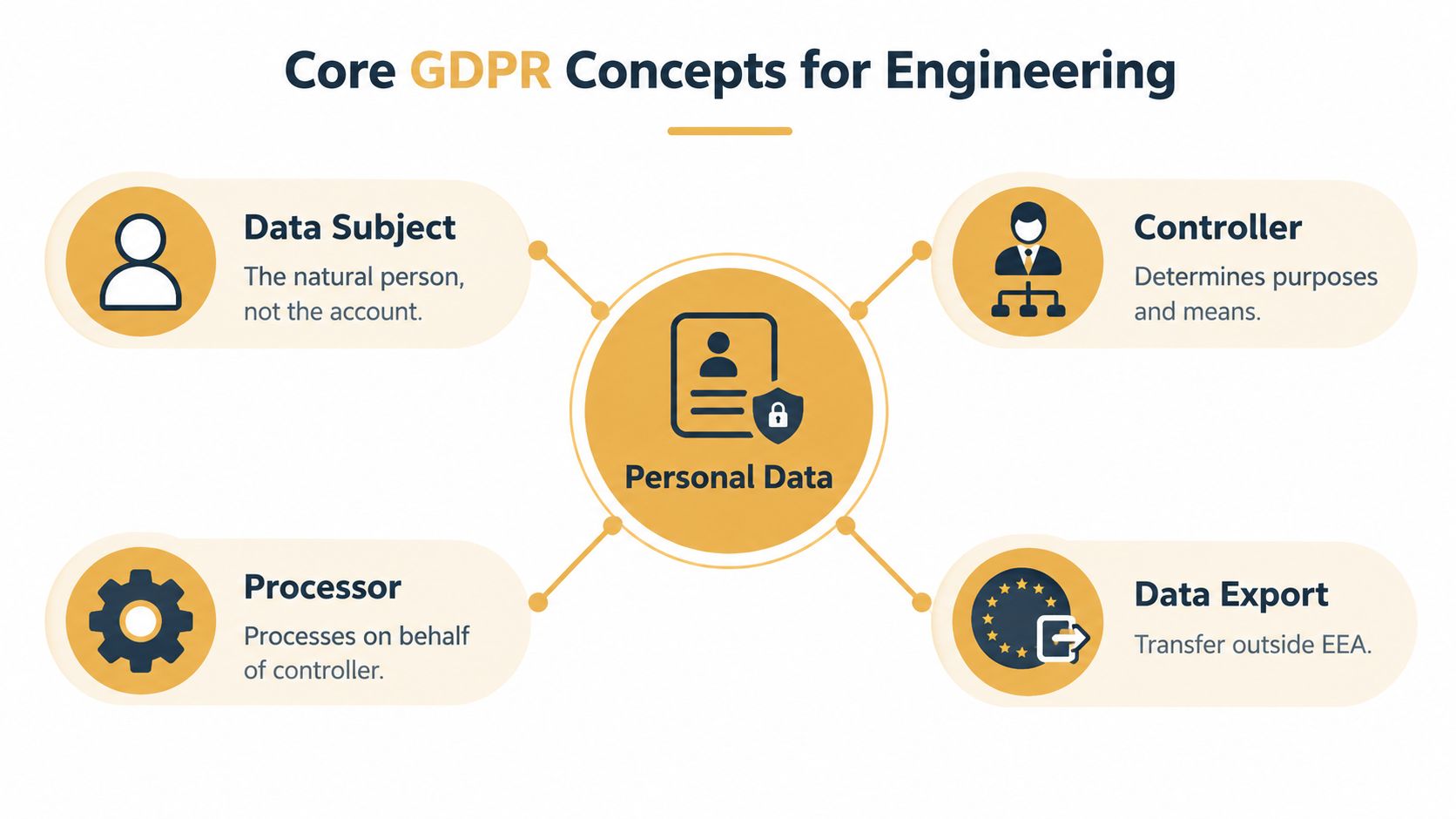
The words in your DPIA and data processing agreement need to match the architecture. Start with four definitions.
Personal data is information related to an identifiable natural person. In an agent system, that includes an email address in a prompt, a support conversation, a user ID linked to a trace, or an embedding that can be connected back to a person. Treat transformed data as personal data when your team can still associate it with an individual.
A data subject is the natural person connected to the data, not the account, workspace, browser, or API key. A shared company account can contain requests from many data subjects, so deleting the account won't necessarily satisfy an individual request.
A controller determines the purposes and means of processing. A processor handles personal data on the controller's behalf under documented instructions. The distinction resembles a restaurant: the restaurant decides what it needs to serve guests and why it stores preferences, while the kitchen prepares the order under the restaurant's direction.
Apply the model to an AI stack
If your team runs an agent on customer input to provide your own service, you're generally the controller for the purposes and means of that prompt processing. A hosted inference platform usually acts as a processor when it processes those prompts on your instructions. The same company can hold different roles in one workflow. It may be a controller for its own account security logs and a processor when routing a customer's data through an agent.
A data export occurs when personal data is transferred or made available outside the EU or EEA. Sending a prompt from an EU-hosted runtime to a US model endpoint is therefore a separate transfer question, not a detail hidden inside the inference SDK.
The six lawful bases are consent, contract, legal obligation, vital interests, public task, and legitimate interests. Record the selected basis per purpose and data flow. Don't write “the agent uses personal data” as one undifferentiated activity, because request logging, persistent memory, and inference can have different purposes and different justifications.
Choosing the Right Lawful Basis for Agent Workloads
Consent shouldn't be your default just because the agent has a user interface. Consent must be specific, informed, and freely withdrawable. In a B2B workflow, making the service conditional on broad consent can also undermine the claim that consent was freely given.
Contract is usually the cleanest basis when the user explicitly asks the agent to perform a service. Apply it narrowly. A request log needed to execute and troubleshoot the requested task may fit, while indefinite shared memory used to personalize future work may require a separate purpose and analysis.
Legitimate interests can support short-lived observability, security, or abuse-prevention data when your team documents the interest, necessity, and balancing test. It doesn't justify collecting everything “just in case.” Put an expiry clock on traces and exclude prompt content from diagnostic logs where metadata is sufficient.
Legal obligation fits retention or disclosure required by law. Store the obligation and retention rule with the dataset. Vital interests and public task rarely fit ordinary SaaS agents, and teams shouldn't select them as convenient alternatives.
| Lawful Basis | Request Logs | Shared Memory | Inference Payloads | Evidence Required |
|---|---|---|---|---|
| Consent | Use only where the user can make a genuine, granular choice | Avoid as a blanket basis for indefinite memory | Record the exact scope and withdrawal path | Consent record, notice, withdrawal workflow |
| Contract | Suitable when logs support the requested service | Limit to memory necessary for delivery | Suitable for an explicitly requested agent action | Contract clause, purpose map, deletion design |
| Legal obligation | Use where retention is mandated | Usually not a general justification | Apply only to a defined legal requirement | Legal source, retention clock, access controls |
| Vital interests | Rarely relevant to SaaS logging | Rarely relevant | Reserved for urgent protection of life | Incident rationale and necessity record |
| Public task | Generally limited to public-authority functions | Not a default for commercial agents | Requires a defined public-interest task | Statutory mandate and processing record |
| Legitimate interests | Strong candidate for proportionate, short-lived telemetry | Requires a careful necessity and balancing analysis | Apply only to a defined operational interest | Balancing test memo, safeguards, opt-out path |
Make the basis drive the architecture
The basis must cascade into implementation. If legitimate interests covers diagnostic traces, your logging pipeline needs a retention control and a way to remove prompt bodies. If contract covers inference payloads, the processor agreement must authorize that processing and identify the model provider or relevant subprocessor. If shared memory has a different purpose, give it a separate record, policy, and deletion path.
Don't let one checkbox cover three datasets. Create a processing inventory with fields for purpose, data categories, subjects, role, lawful basis, destination, retention, and rights workflow. That inventory becomes the source for your DPIA, Article 30 records, vendor review, and runtime configuration.
Honoring Data Subject Rights on Always-On Agents
An always-on agent turns a rights request into a distributed systems problem. The data subject may appear in a prompt, a conversation transcript, an embedding, a tool result, a cached model response, an audit event, and a backup snapshot. Your support team needs one request ID that fans out across every storage and processing boundary.
| Right | Agent Touchpoint | Engineering Action | Common Blocker |
|---|---|---|---|
| Access | Prompt history, traces, memory, tool records | Build a subject search and export package | Data is split across vendors |
| Rectification | Profile facts and stored memory | Update canonical records and regenerate affected memory | The original source isn't identified |
| Erasure | Raw logs, vectors, caches, backups | Delete or irreversibly suppress all linked records | Orphan replicas and vendor backups |
| Restriction | Agent retrieval and processing queues | Mark records unavailable while preserving required evidence | Runtime ignores restriction flags |
| Portability | User-created prompts and outputs | Export structured, machine-readable data | Memory is stored as opaque vendor files |
| Objection | Profiling, personalization, legitimate-interest telemetry | Stop the relevant purpose without disabling the whole service | Shared infrastructure has coarse controls |
| Automated decision-making opt-out | Scoring, routing, eligibility, or other significant decisions | Add human review and a processing bypass | Agent workflow assumes automation is mandatory |
| Notification | Downstream processors and recipients | Propagate corrections, erasure, or restriction notices | Vendor contracts lack notification duties |
The difficult rights are erasure, portability, and objection. Deleting a row from a vector index isn't enough if the same content remains in a Markdown memory file, a cache, a trace archive, or a processor-side backup. Exporting “the user's account” also isn't enough if the user has interacted with several agents sharing one memory namespace.
Design the deletion graph first
Give every personal-data-bearing object a stable subject reference where possible. Keep a manifest of derived objects, including embedding IDs, memory paths, trace IDs, and outbound request references. Then make deletion idempotent, auditable, and scoped by tenant and subject.
Your vendor contract must state how processors handle deletion, restrictions, export, subprocessors, and backups. Internal code can't erase data from a hosted model endpoint or a provider's retained logs unless the service exposes the necessary control.
For operational visibility, a monitoring layer such as an AI agent monitoring dashboard should expose retention status, access events, outbound destinations, and failed deletion jobs. Monitoring isn't proof of compliance by itself, but it gives the privacy team evidence that the workflow runs and shows where it stopped.
Controller vs Processor Responsibilities in Cloud Hosting
The controller decides why the agent processes personal data and how the service uses it. The processor runs the infrastructure or service under the controller's documented instructions. A hosting provider doesn't become the controller merely because it operates the machine, and your team doesn't escape responsibility because a vendor supplies the runtime.
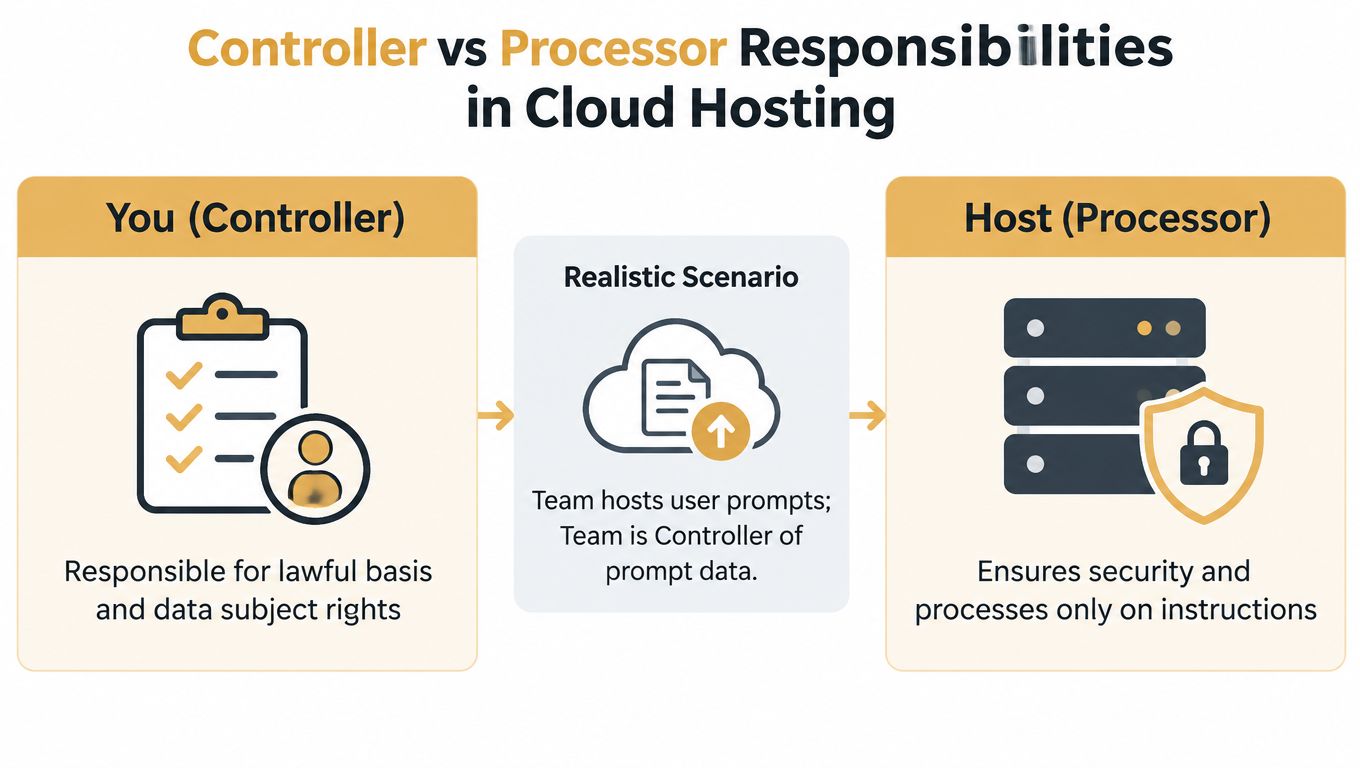
Consider a platform team that offers an AI support agent to business customers. The team is likely a controller for data used to operate its own service, including account administration and service security. When a customer routes its end-user conversations through that agent, the platform may be a processor acting on the customer's instructions. The same request can then pass to a model provider as a subprocessor.
Responsibilities must follow the data path
The controller owns the purpose, lawful basis, transparency, rights handling, DPIA decision, and instructions to processors. It must know what the agent does with data and be able to demonstrate accountability.
The processor must process data only on documented instructions, apply appropriate security measures, support the controller's rights obligations, assist with breach response, maintain relevant records, and return or delete data when the service ends. Article 28 terms should identify approved subprocessors, change-notification procedures, confidentiality obligations, audit support, retention, deletion, and international transfer mechanisms.
The EU GDPR guidance for businesses states that GDPR can apply to non-EU companies targeting or monitoring people in the EU, and such businesses must appoint an EU representative where the conditions apply. The guidance also makes the territorial point clear: processing location doesn't erase obligations created by targeting or monitoring people in the EU.
Avoid the role ambiguity that breaks audits
Document each boundary in a role matrix:
Your service: purpose, lawful basis, controller or processor role, retention, rights owner.
Hosting layer: machine isolation, storage, logs, support access, deletion mechanism.
Inference provider: payload use, retention, training restrictions, region, subprocessors.
Connected tools: Slack, GitHub, Gmail, Notion, or ticketing systems receiving agent outputs.
Customer: instructions, notices, subject relationship, approved use cases.
Joint controllership needs a separate analysis when parties jointly determine purposes and means. Don't label every vendor a processor to simplify procurement. A regulator will examine actual decisions, not the title in your contract.
When a DPIA Is Required and What It Must Contain
Run DPIA screening before an agent reaches production. A full DPIA is required when processing is likely to create a high risk to individuals, including large-scale processing of sensitive data and automated decision-making or profiling that produces legal or similarly significant effects. An agent that merely drafts internal text isn't automatically equivalent to an agent that ranks people, approves access, or triggers consequential decisions.
| DPIA Section | What Regulators Expect | Agent-Specific Evidence |
|---|---|---|
| Processing description | Purposes, data, subjects, systems, recipients | Agent topology, prompt schemas, memory flow, tools |
| Necessity and proportionality | Why the processing is needed and limited | Field-level minimization, retrieval scope, retention rules |
| Risk assessment | Risks to rights and freedoms | Prompt leakage, profiling, autonomous actions, cross-border access |
| Mitigations | Technical and organisational safeguards | IAM policy, encryption, human approval gates, deletion tests |
| Residual risk | Remaining exposure after controls | Risk register, owner, acceptance decision |
| Consultation | Prior consultation where high residual risk remains | DPO review, supervisory-authority record where applicable |
Build an evidence stack, not a narrative
For autonomous code execution, document the permissions that limit filesystem, network, credentials, and deployment actions. For persistent memory, show tenant separation, subject lookup, retention enforcement, and deletion propagation. For third-party tool calls, list recipients, fields sent, regions, subprocessors, and failure behavior.
A useful DPIA packet contains the architecture diagram, processing inventory, data classification, threat model, lawful-basis records, vendor contracts, access-control exports, retention configuration, rights-request tests, incident runbook, and approval history. Keep evidence versioned with the deployment, because a DPIA that describes last quarter's agent isn't evidence for today's runtime.
Security and Privacy by Design for AI Platforms
Article 25 requires privacy safeguards to be built into processing means and defaults. The EDPB guidance on data protection by design and by default emphasizes minimization, limited retention, and need-to-know access. Article 32 adds risk-based technical and organisational controls, including pseudonymisation, encryption, confidentiality, integrity, availability, resilience, restoration, and regular testing, as set out in Article 32 GDPR.
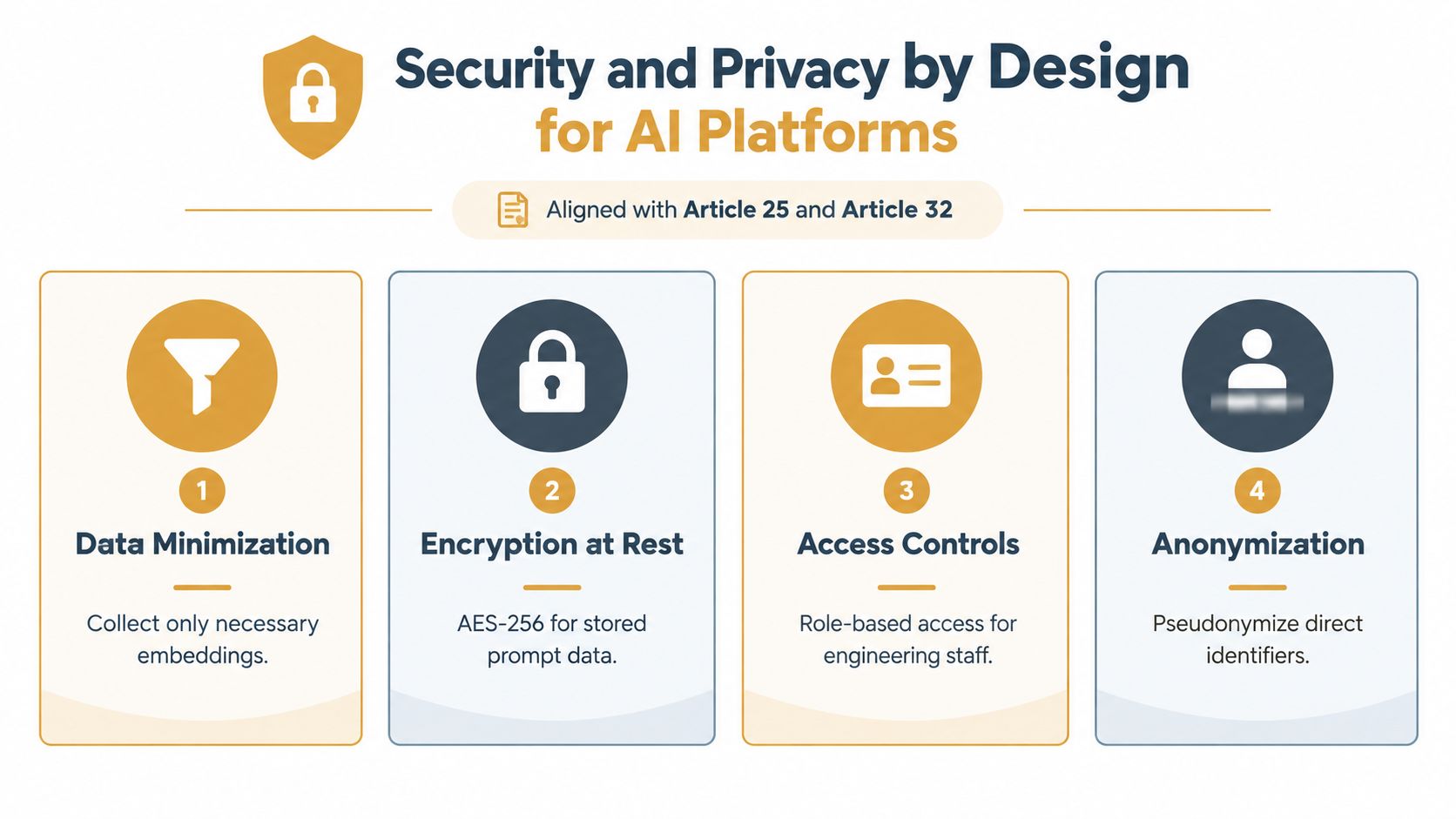
Apply those requirements as code-level defaults:
Minimize at ingestion: Drop unnecessary identifiers before prompts reach logs, embeddings, or model endpoints.
Encrypt each layer: Use encryption in transit and at rest, with key ownership and access separated from application permissions.
Scope access per run: Give each agent execution the minimum credentials and memory namespace it needs.
Set retention at creation: Require an expiry policy for traces, memory, caches, and backups before a workload can deploy.
Make audits append-only: Record administrative access, exports, deletions, region changes, and outbound transfers in tamper-resistant logs.
Test restoration and deletion: A backup that can't be restored safely, or erased when required, is an unverified control.
Choose regions deliberately: Keep storage, shared memory, inference, support access, and backups aligned with the controller's residency requirement.
Practical rule: A privacy setting hidden behind an administrator screen isn't a privacy-by-default control. The secure and minimal option should be the initial state.
EU residency doesn't mean every processing activity stays in the EU automatically. Confirm the inference route, support access model, subprocessors, telemetry destination, and disaster-recovery region. For credential handling and agent integrations, use a dedicated credential security workflow with scoped secrets, rotation, access logging, and no prompt exposure.
The essential requirements are minimization, encryption, least privilege, retention enforcement, access logging, and tested deletion. Customer-managed keys, confidential computing, and advanced anonymization can strengthen the posture, but they don't compensate for an unbounded memory store or an undocumented model transfer.
Implementation Checklist for EU-Compliant Agent Hosting
A hosted platform doesn't make your processing compliant by default. It can provide region controls, isolation, access management, and audit features, but your team still chooses the purpose, sends the payload, configures retention, approves vendors, and answers the data subject.
Use an owner-based launch checklist:
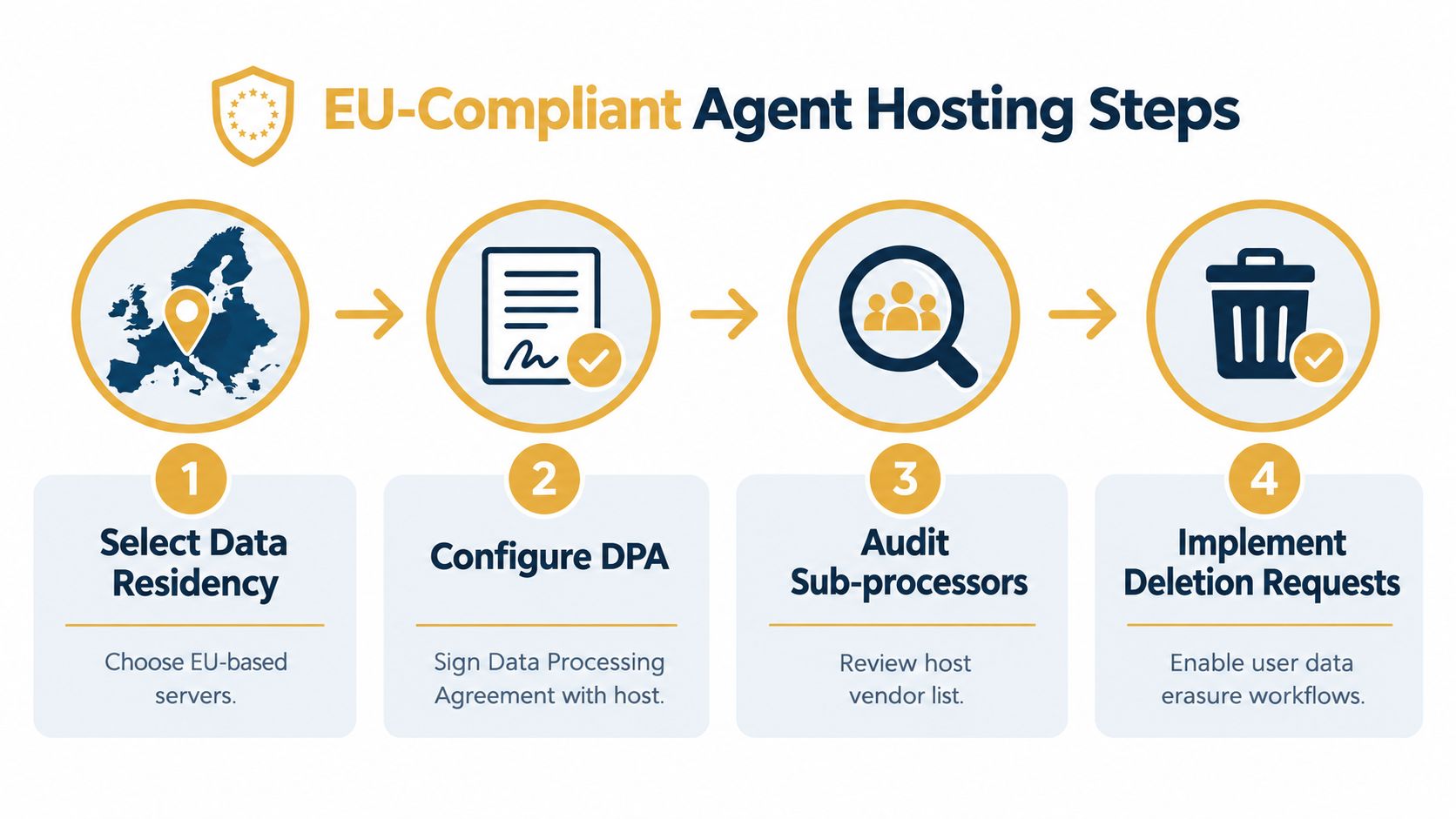
Platform owner, select residency: Choose the EU region for runtime and storage, then verify vector memory, backups, logs, support access, and inference routing separately.
Privacy owner, sign the DPA: Confirm controller and processor roles, documented instructions, confidentiality, rights assistance, deletion, breach support, audit rights, and subprocessor terms.
Security owner, enforce access: Require SSO and RBAC, isolate agent credentials, restrict shared memory namespaces, and review administrative access.
Data owner, classify fields: Mark prompt fields, tool responses, embeddings, traces, and outputs by sensitivity. Remove fields the agent doesn't need.
Reliability owner, test lifecycle controls: Run deletion, export, restoration, retention expiry, and incident exercises against real data paths.
Vendor owner, review subprocessors: Check the provider's subprocessor list, transfer mechanism, inference destinations, support model, and change notifications.
Compliance owner, assemble evidence: Store the processing record, DPIA screening, approvals, configuration snapshot, contract, risk assessment, and test results with the release.
Demand operational proof from the host
Ask the provider precise questions. Can you select EU storage and inference independently? Are backups covered by the same region promise? Can you delete one subject's raw prompts and derived embeddings? Does the host retain inference payloads? Which subprocessors receive data? How quickly will the provider notify you of a breach? Can your team export audit events in a usable format?
Sokko offers managed hosting for always-on AI agents, isolated machines, EU data residency options for storage and shared memory, and EU-hosted inference options for eligible configurations. Treat those capabilities as inputs to your control design, not as a substitute for your DPA, DPIA, retention policy, or rights workflow.
Your pre-launch evidence pack should let an auditor trace one prompt from ingestion to deletion. If your team can't identify every copy, every recipient, and every owner, the deployment isn't ready for EU workloads.
Configure your agent hosting around the data flows you operate, then test deletion, access, residency, and vendor boundaries before users depend on the system. Sokko provides isolated always-on agent hosting with EU-region options and operational visibility for teams that need to turn those GDPR requirements into deployable controls.