
Your AI team deploys a new feature on infrastructure located in the EU. The database is region-pinned, the customer contract promises European hosting, and everyone signs off. A week later, an engineer discovers that prompt logs are copied to a global observability service, model requests sometimes fail over to a non-EU endpoint, and a support vendor can access production data from outside Europe.
The deployment may be EU-hosted, but the workload isn't necessarily EU-resident.
That distinction creates much of the confusion around EU residency requirements. Teams often treat residency as a cloud-region setting or assume GDPR automatically requires all personal data to stay inside the European Union. Neither assumption is reliable. Residency is a technical and contractual choice about where data is stored and processed. GDPR regulates international transfers through a separate legal framework.
A defensible approach connects both layers. You need to know which data is covered, where it travels during its full lifecycle, which transfer mechanism applies when it leaves the EEA, and whether your infrastructure can prevent accidental movement. The practical challenge is larger for AI systems because requests generate more than a database record. They can produce prompts, outputs, embeddings, caches, traces, backups, support tickets, and audit trails.
This guide starts with the legal and technical distinction, then moves through applicability, control options, AI implementation, common failure modes, and verification. The aim isn't to force every workload into EU-only infrastructure. It's to help engineering and legal teams choose a proportionate design and prove that the design still works after the next deployment.
Table of Contents
What EU Data Residency Really Means and How It Differs From GDPR Transfers
Hosting Transfer and Contractual Controls That Enforce Residency
How to Implement EU Only Residency for AI Workloads and Inference
Introduction Why EU Residency Confuses Even Good Teams
A product manager may ask for “EU data residency” as a procurement requirement. An engineer may interpret that as selecting an EU cloud region. A privacy counsel may focus on whether a transfer outside the EEA has an appropriate safeguard. All three are discussing legitimate concerns, but they aren't answering the same question.
The first question is where data is stored and processed. That includes primary databases, object storage, caches, backups, search indexes, vector databases, and model endpoints. The second is whether personal data crosses the EEA boundary. That includes remote administration, support access, telemetry collection, third-party analytics, and failover. The third is what the organization has promised in customer contracts, security schedules, procurement questionnaires, and internal policies.
A team can satisfy one question and fail another. EU storage doesn't automatically resolve a transfer created by a support engineer accessing a record from abroad. Conversely, a lawful transfer mechanism may allow processing outside the EEA even when a customer contract requires EU-only hosting.
Practical rule: Treat “EU-hosted” as a deployment property, not as proof that the entire data flow stays in Europe.
AI makes the boundary harder to see. A request might enter through an EU gateway, pass to an EU model endpoint, generate an embedding in an EU service, and then appear in a logging system with a different geographic policy. If engineers inspect only the application database, they'll miss the locations that matter during inference and operations.
The rest of this article uses a simple principle: residency is an end-to-end engineering boundary, while GDPR transfer law is the legal framework for data leaving the EEA. Once those ideas are separated, teams can decide when EU-only infrastructure is necessary, when contractual safeguards may be sufficient, and how to test the result.
What EU Data Residency Really Means and How It Differs From GDPR Transfers
Think of a library. Residency tells you which building holds a book and where people read it. Transfer law governs the rules for lending that book to another building. The first is a location and architecture decision. The second asks whether the receiving building provides an adequate protection framework and whether the loan follows approved conditions.
Data residency describes the geographic location where data is stored or processed. A company might choose EU regions because a customer requires them, because its risk policy prefers them, or because keeping data in-region simplifies assurance. That choice can cover databases, backups, inference, logs, and operational tooling.
GDPR takes a different route. It does not impose a blanket requirement that personal data be stored only inside the EU or EEA. Instead, GDPR Chapter V, Articles 44 to 49, regulates transfers outside the EEA. An organization can store EU personal data elsewhere when it uses a valid mechanism, such as an adequacy decision, Standard Contractual Clauses, Binding Corporate Rules, or another approved safeguard. The distinction is set out in this overview of EU and US data residency requirements.
The geographic scope
The European Economic Area includes 30 countries, the 27 EU member states plus Iceland, Liechtenstein, and Norway. That scope matters for infrastructure teams because an “EEA-only” policy covers a broader area than the EU alone.
The legal question isn't whether a server sits inside a preferred country. GDPR's transfer framework asks whether data moving outside the EEA retains an essentially equivalent level of protection. Location can make that easier to demonstrate, but location by itself isn't the entire legal analysis.
Three concepts that teams should keep separate
Residency: Where data is physically stored or processed.
Transfer compliance: Which legal mechanism permits personal data to move outside the EEA.
Sovereignty: Which legal authority may govern the data, provider, infrastructure, and access decisions.
These concepts overlap in risk reviews, but they aren't interchangeable. Encryption may reduce unauthorized access risk without changing where the ciphertext is stored. An SCC may support a lawful transfer without satisfying a customer promise that data remain exclusively in EU locations. An EU data center may hold production data while a provider's support workflow creates access from another jurisdiction.
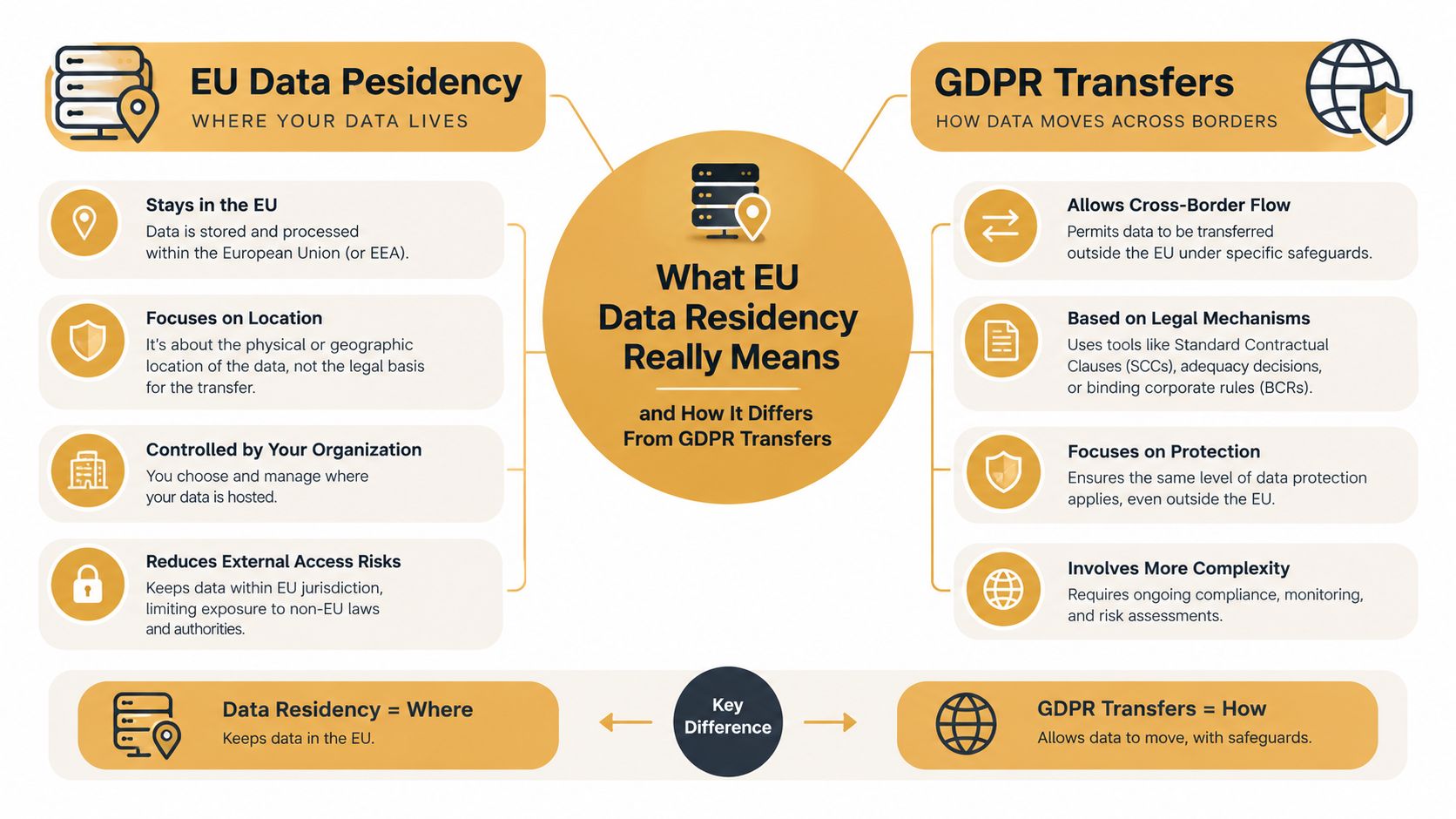
The useful explanation for stakeholders is short: residency answers “where does it live?” GDPR transfer law answers “what protects it if it leaves?” A complete architecture document should answer both.
When EU Residency Requirements Actually Apply
There isn't one universal EU-only hosting rule for every organization or dataset. The requirement usually comes from a combination of data sensitivity, sector expectations, customer contracts, public-sector procurement, internal risk appetite, and the operational consequences of a transfer.
A SaaS product processing ordinary business contact details may be able to use an approved transfer mechanism for a service outside the EEA. A public-sector customer, a regulated enterprise, or a buyer with a strict procurement policy may still require EU-only storage and processing. The legal minimum and the commercial requirement can differ.

Start with the dataset, not the region
Classify the data before selecting infrastructure. Customer prompts containing personal information, employee records, support conversations, identity documents, and behavioral telemetry may need different handling from anonymized metrics or code that contains no personal data.
Then map the processing purpose. A system may store customer content in Europe but send selected text to an external model for inference. That model call is a separate flow and needs its own assessment. The same applies to alerting, product analytics, ticketing, abuse detection, and human support.
A practical inventory asks:
Which data categories contain personal data?
Which users or customers are connected to the EEA?
Which vendors receive, store, process, or can access that data?
Does a contract promise EU-only handling?
Can the system route, fail over, or export data automatically?
Sector and contract pressure
Regulated industries and public-sector buyers often use residency as a risk-control requirement even when GDPR could permit a safeguarded transfer. Enterprise procurement teams may ask for regional hosting because it makes their own vendor assessment easier. A provider that can't meet that condition may lose the contract without having violated GDPR.
AI governance can add another layer. Teams building systems for European customers should review the EU AI Act and its operational implications alongside privacy requirements. The applicable obligations depend on the system and use case, so residency shouldn't be presented as a substitute for broader governance.
The right response isn't to force every dataset into the same architecture. Separate workloads by risk and customer promise, then apply stronger controls where the consequences justify them. A team might keep identifiable prompts, embeddings, logs, and support records in the EU while allowing carefully governed, non-personal operational metrics to use a broader platform.
Decision test: If a customer, regulator, or auditor asked where the data could appear at every stage, could your team answer without relying on a provider's marketing description?
Hosting Transfer and Contractual Controls That Enforce Residency
A durable residency posture uses three levers together:
Hosting controls determine where systems store and process data.
Transfer controls establish the legal basis when personal data moves outside the EEA.
Contractual controls define what providers promise, permit, and disclose.
A region selection handles only the first lever. It doesn't automatically constrain backups, vendor support, subprocessors, model routing, or diagnostic exports.
The 2020 Schrems II ruling invalidated the EU-US Privacy Shield and increased reliance on SCCs with supplementary safeguards. The European Commission's updated SCCs became mandatory for new contracts signed after 27 September 2021, and older contracts had to transition by 27 December 2022, as summarized in this Schrems II and SCC timeline.
Choosing your control mix
| Scenario | Recommended Control | Why It Works |
|---|---|---|
| A provider outside the EEA is covered by an applicable adequacy decision | Adequacy decision plus ordinary GDPR governance | The recognized decision supplies the transfer mechanism, while contracts and access controls govern the processing relationship |
| A transfer goes to a jurisdiction without an adequacy decision | Current SCCs, supplementary safeguards, and a documented assessment | The contractual mechanism addresses the transfer, while technical and organizational measures support equivalent protection |
| A customer contract requires EU-only handling | EU-hosted storage and processing, with regional backups, logs, support controls, and inference | The architecture aligns the technical boundary with the contractual promise |
| An AI workload has sensitive prompts and operational traces | EU-only request path, model endpoint, vector store, observability, and audit trail | It reduces hidden transfer paths that a database-only review would miss |
Contracts should match the architecture. Review data processing agreements, subprocessors, support access, backup locations, deletion behavior, incident obligations, and any provider right to change regions. If customer-controlled encryption keys are part of the design, document who controls them and where key-management operations occur. A bring-your-own-keys approach can support separation of control, but encryption doesn't by itself make a non-EU location into an EU location.
The trade-off is practical. EU-only infrastructure may simplify customer assurance and reduce transfer analysis, while a broader provider footprint may offer more services or operational flexibility. SCCs can support international architecture, but they require active governance rather than a signed document placed in a repository and forgotten.
How to Implement EU Only Residency for AI Workloads and Inference
For AI, the boundary should follow the request from entry to deletion. Industry guidance describes this as covering the gateway, model endpoint, backups, logs, and audit trails, with inference routed to EU-hosted endpoints, vector databases and observability kept in-region, and cluster policy used to block silent failover. The engineering pattern is described in this guide to residency and sovereignty for enterprise AI agents.
Begin at the gateway
Route an EU tenant to an EU gateway and attach the region as an enforced policy attribute. Don't rely on an application developer remembering which model URL to use. The gateway should reject a request when the approved EU route is unavailable, rather than forwarding the prompt to a global fallback.
The same rule applies to agent tools. If an agent can call search, email, ticketing, or code services, identify whether those tools receive prompt content or personal data. A regionally compliant model endpoint doesn't help if the agent sends the same content to a tool with unrestricted geographic processing.
Keep derived data inside the boundary
Embeddings and vector records can reveal information about the source content, so store the vector database in an approved EU location. Retain metadata, access events, and retrieval traces under the same policy. Teams sometimes protect the source database while overlooking the derived index that makes the content searchable.
Backups need an explicit region policy too. Check snapshots, disaster-recovery replicas, object-storage exports, and managed-service backups. A primary database in the EU doesn't establish EU-only residency if restoration data is copied elsewhere.
Treat observability as production data
Prompt logs, sampled model outputs, traces, error payloads, and debugging captures can contain the same personal data as the original request. Keep the logging pipeline, dashboards, retention stores, and audit trails in-region, and redact content before it enters systems that don't meet the residency policy.
Sokko is one option teams can evaluate for agent workloads because it offers US and EU regions, EU data residency for storage and shared memory, and EU-hosted inference options. It should still be assessed against the specific data flows, support model, contract terms, and controls your organization requires.
Enforce the policy at the cluster layer
Application configuration can drift. A cluster-level policy should restrict permitted regions for compute, storage, model endpoints, backups, telemetry, and failover. Test the policy by deliberately making the preferred endpoint unavailable and confirming that the request fails safely instead of crossing the boundary.
Use this checklist:
Gateway: Pin tenant traffic to the approved EU route.
Inference: Verify the model endpoint and every fallback endpoint.
Memory: Keep vector stores, shared memory, caches, and indexes in-region.
Telemetry: Review prompt logging, sampling, traces, metrics, and dashboards.
Recovery: Confirm that snapshots and disaster-recovery copies use approved locations.
Access: Record administrator and support access paths, not only storage locations.
Audit: Preserve evidence showing routing, denials, access, and deletion.
A region-aware data center selection process helps at the beginning, but runtime policy and continuous testing determine whether the boundary survives change.
Common Misconceptions That Break EU Residency
“Our data is in an EU database, so the workload is EU-resident.”
That conclusion ignores logs, backups, support sessions, analytics collectors, and model calls. A prompt copied into a global error tracker has left the intended boundary even if the source record remains in Europe. Review the full request lifecycle, not the most visible storage layer.
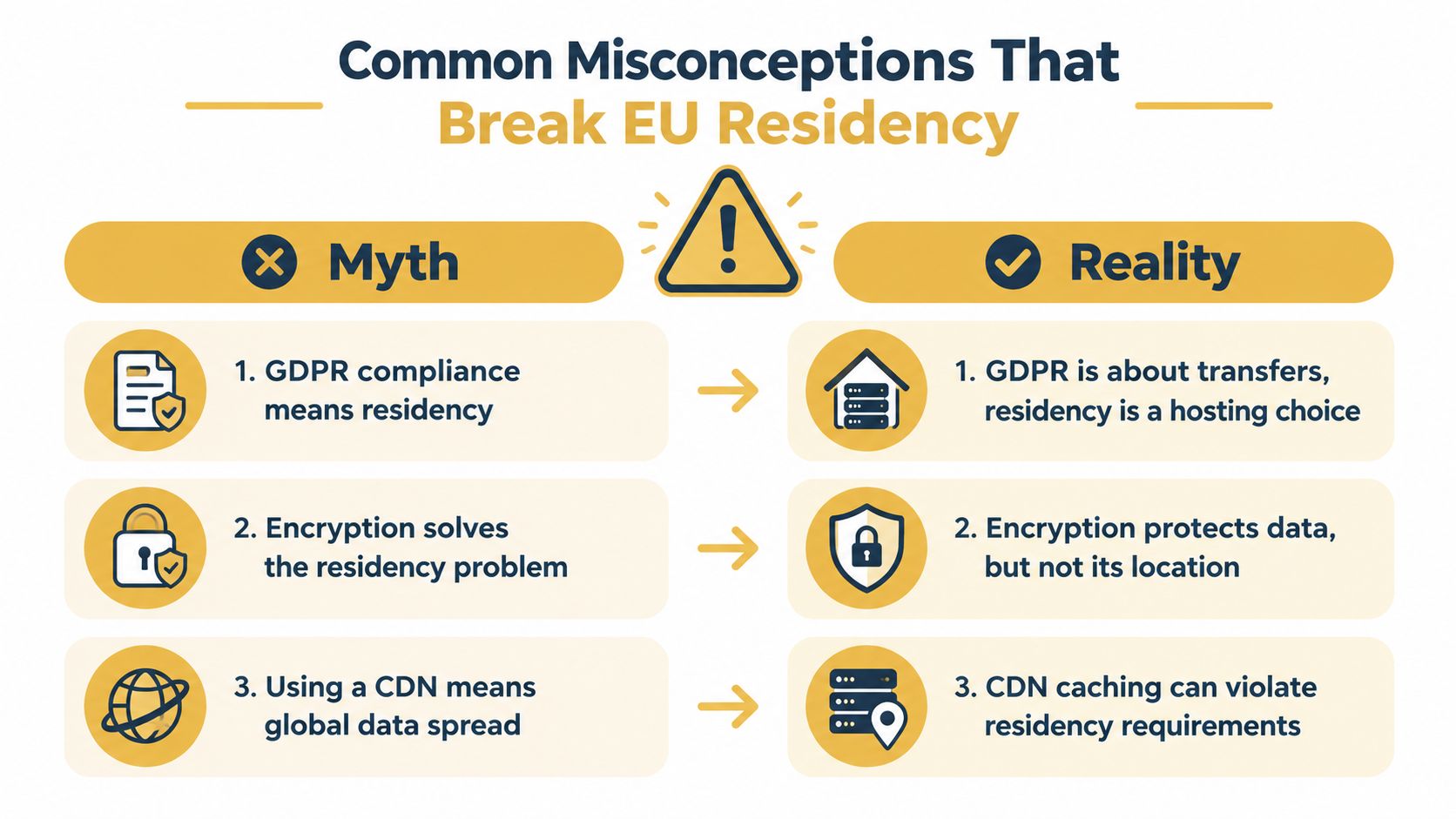
“GDPR compliance means we must store everything in the EU.”
GDPR doesn't impose a blanket EU or EEA storage mandate. It regulates transfers outside the EEA through Chapter V and recognized safeguards. An organization may choose EU-only hosting for contractual, operational, or risk reasons, but that choice is different from claiming that GDPR always requires it.
“Encryption solves the residency problem.”
Encryption helps protect confidentiality and can reduce exposure if unauthorized parties obtain the data. It doesn't change the physical location of the encrypted data, the jurisdiction connected to the provider, or the fact that a model endpoint processed the request elsewhere.
The access paths teams forget
A provider's support team may access records during incident response. A monitoring vendor may receive sampled prompts. A subprocesser may store ticket attachments in a different region. These are data-flow questions, and the organization needs to know whether each path is blocked, contractually covered, or subject to another safeguard.
CDNs create a related risk. Caching content at globally distributed edge locations can conflict with an EU-only policy when the cached material contains personal data. Teams should apply residency rules to caches and delivery services, not assume that a CDN is merely a performance layer.
The practical pattern behind these failures is assumption replacing verification. A vendor may advertise EU hosting while retaining global support access. An application may select an EU endpoint while its SDK sends telemetry elsewhere. A contract may mention regional storage without covering backups or derived data.
Choosing and Verifying Your EU Residency Approach
Choose EU-only residency when a customer contract requires it, your risk assessment treats cross-border access as unacceptable, or the workload's data and operational model make transfer governance disproportionate. Choose a safeguarded international design when the business needs a broader footprint and the team can document every transfer, provider, access path, and technical safeguard.
Then verify the decision with evidence:
Map the flow. Trace collection, inference, storage, embeddings, logs, backups, support, and deletion.
Test failure. Disable the preferred EU endpoint and confirm the system denies or queues the request instead of failing over globally.
Review providers. Check regions, subprocessors, support access, backup behavior, and contract commitments.
Document mechanisms. Record the applicable adequacy decision, SCCs, BCRs, or other safeguard for each relevant transfer.
Recheck after change. Treat new models, observability tools, agents, and integrations as residency-impacting changes.
A useful control isn't merely a policy statement. It's a route that can be observed, a fallback that can be tested, and an audit record that another team can understand. Keep the legal assessment and the infrastructure map together so neither becomes outdated while the other changes.
For teams deploying AI agents, Sokko offers regional hosting with EU data residency for storage and shared memory, plus EU-hosted inference options that can support an EU-only workload design. Review the architecture and control requirements against your data flows, then visit Sokko to evaluate whether its EU deployment options fit your team.