
Your support fleet has a shared customer problem, but not necessarily shared customer context. A support agent approves a refund at 10:14 because the customer says they'll churn. Five seconds later, a retention agent offers a discount because its last-known state says the customer is satisfied. Neither agent is irrational. They're operating from different memories.
That incident is the practical starting point for shared memory vs distributed memory. Shared memory gives agents one persistent view of important facts. Distributed memory gives each agent its own state and makes synchronization explicit. The right choice depends less on whether you call the system “memory” and more on who owns the canonical truth, how quickly writes become visible, and what happens when one component fails.
| Dimension | Shared Persistent Memory | Distributed Per-Agent Memory |
|---|---|---|
| Coordination | Agents read and write a common state | Agents coordinate through messages or replication |
| Freshness | New writes can become visible to every authorized agent | State may diverge until synchronization occurs |
| Isolation | Requires namespaces and access policies | Isolation is the default |
| Scaling pressure | Contention moves toward the shared store | Storage and coordination scale with agents |
| Failure blast radius | A bad write can affect many agents | A failure usually stays closer to one agent |
| Best fit | Shared workflows and common customer context | Independent tasks, tenant boundaries, and local scratch state |
Table of Contents
When Two Agents Disagree on the Same Customer
At 10:14, the support agent writes refund approved after reading the latest conversation. At 10:14:05, the retention agent reads an older summary and writes discount offered. The customer now has two incompatible promises in the system, even though the underlying record never changed twice.
With shared memory, both agents use one global address space or one canonical persistence layer. The support agent writes an event, and the retention agent can read that event from the same store. In a managed agent fleet, that store might be Redis, Postgres, or a managed key-value service. The key property isn't the brand or database engine. It's that all authorized agents consult the same durable state.
With distributed memory, each agent owns its own address space. The support agent might keep a local conversation summary, while the retention agent stores its own embeddings and task history. They can exchange messages or replicate selected records, but the system must define when and how that exchange happens.

The distinction has deep roots in parallel computing. Shared-memory systems let processors access a global address space, but memory contention and bus saturation limit scaling. A University of Colorado lecture on parallel computer architecture notes that shared-bus parallel computers reached a limit of 32 processors in the early 1990s, helping drive adoption of distributed-memory designs and message passing.
That history maps neatly onto agents. Shared memory reduces the glue code needed to reconcile facts, but it concentrates contention and failure. Distributed memory isolates work and can scale across independent workers, but every cross-agent fact needs a communication path.
Practical rule: If two agents can make conflicting decisions during the same customer request, start by asking why they aren't reading one canonical state.
What Shared and Distributed Memory Actually Mean for Agents
Use a whiteboard to build the right mental model.
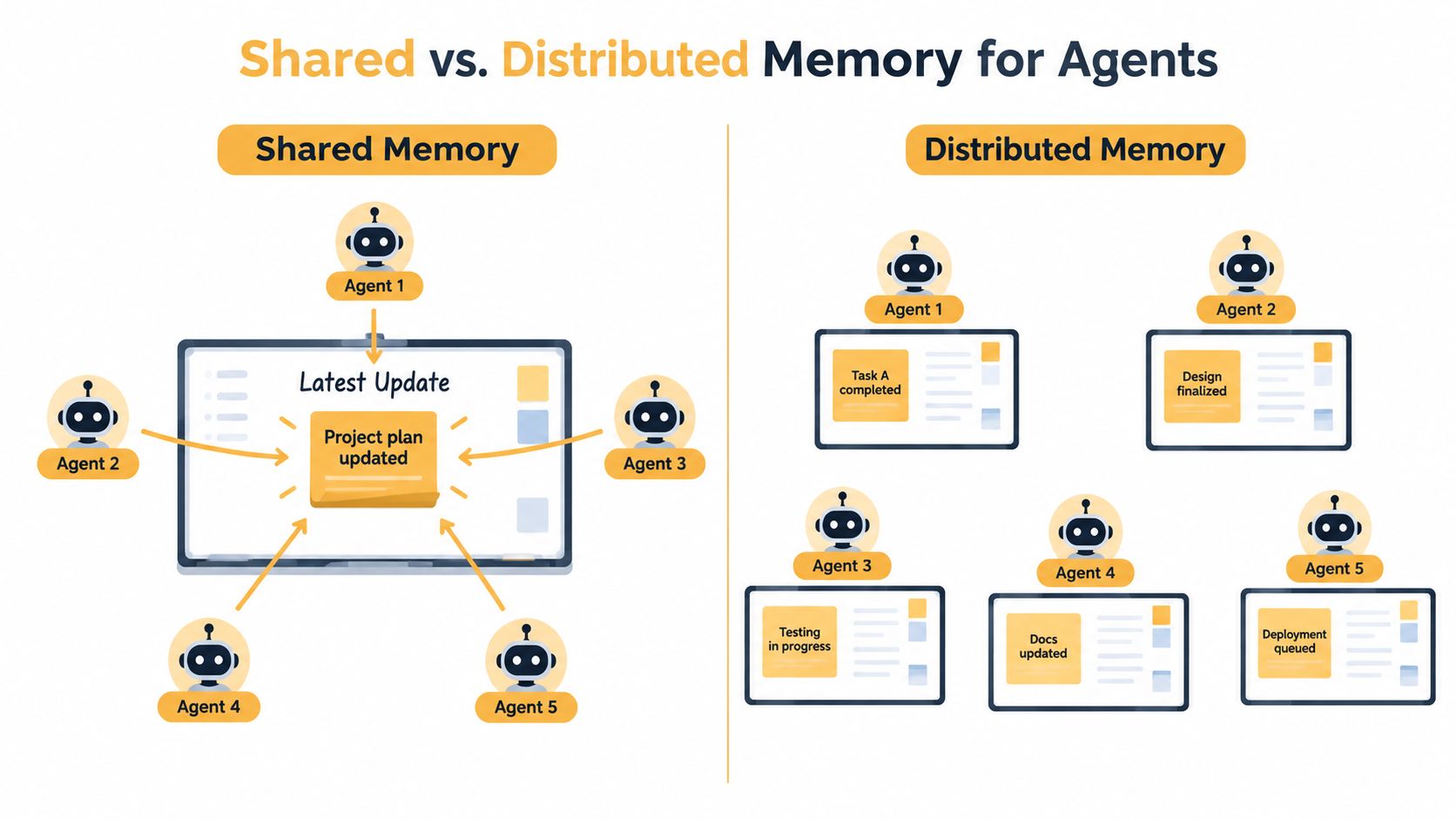
Shared memory is one wall for the whole team. Every agent can read the same notes, and authorized agents can add or revise them. A support agent records a customer preference, a billing agent records payment status, and a retention agent sees both without waiting for a hand-built handoff.
Distributed memory is a set of notebooks. Each agent keeps its own working state, history, cache, or long-term store. An agent can send a page to another agent, publish an event, or replicate selected records, but the copies don't become identical by accident.
The architecture question isn't RAM versus disk. It has three parts:
Ownership: Which component is responsible for the canonical fact?
Visibility: When does another agent see a write?
Authority: Which agents can read, append, update, or delete it?
A shared setup might use Redis for fast coordination, Postgres for structured records, or a managed key-value store for durable facts. A distributed setup might give each agent a scoped SQLite database, a private vector database, or an isolated namespace. You can also combine them. Local agent caches handle immediate reasoning, while a shared store holds committed facts that other agents must trust.
For agents, persistent memory includes more than chat history. It can include tool results, customer preferences, workflow status, prior decisions, task ownership, and summaries of long-running work. The guide to AI agent persistent memory is useful background because it treats memory as state that survives conversations and restarts, not merely text injected into a prompt.
Shared memory is easier to reason about when the workflow has one customer, one ticket, or one deployment state. Distributed memory is easier to defend when agents operate on separate tenants, separate documents, or independent jobs. The mistake is choosing based on infrastructure fashion instead of identifying the records that must remain coherent.
Comparing the Trade-offs Side by Side
The table below is the decision surface I use when reviewing an agent fleet. It separates coordination behavior from raw machine performance, because those aren't the same problem.
| Dimension | Shared Persistent Memory | Distributed (Per-Agent) Memory |
|---|---|---|
| Latency | A single-region store can provide a direct coordination path, but every access still depends on the shared tier | Local reads are fast and predictable, while cross-agent reads require messaging or synchronization |
| Consistency | Agents can work from one canonical record, provided writes are coordinated | Each agent can remain internally consistent, but replicas may be stale or contradictory |
| Access control | Requires carefully scoped namespaces, roles, and write rules | Agent or tenant boundaries are natural, with explicit sharing for selected artifacts |
| Scaling | The memory service absorbs more readers and writers, so contention must be managed there | Agents and their stores scale independently, but coordination traffic grows with shared work |
| Failure modes | A malformed write, bad migration, or unavailable store can affect many agents | One agent or local store can fail without necessarily taking down the fleet |
| Cost | You pay for a durable shared service and its availability, backups, and operational controls | You pay for duplicated storage, synchronization, and the engineering needed to reconcile copies |
Latency is about the path you measure
A local in-memory cache will beat a networked shared store for a hot read. That doesn't make local caches the right coordination layer. If the next agent needs to see a newly committed customer decision, the relevant measurement is the full cross-agent path, including serialization, authorization, network access, and consistency handling.
A single-region shared store often beats cross-zone replication for freshness-sensitive coordination because the write has fewer replication steps. Distributed memory can win for independent work because agents avoid the shared hop entirely. You need separate measurements for local reasoning, shared reads, shared writes, and tail behavior.
Failure isolation changes the risk calculation
Shared memory creates a correlated blast radius. One agent that writes an incorrect customer status can steer every reader toward the same bad decision. That risk is manageable with append-only events, schema validation, optimistic concurrency, and clear ownership, but it doesn't disappear.
Distributed memory fails differently. One agent may lose its notebook or publish a stale result while the rest of the fleet continues operating. The cost moves from shared corruption to synchronization and reconciliation. A system that handles separate jobs should usually accept that trade. A system that coordinates one customer journey usually shouldn't.
The University of Alberta technical report on distributed shared memory captures the underlying architectural tension: shared memory is easier for programmers to use but difficult to build at scale, while distributed memory can be assembled from separate machines but makes data movement explicit. Agent platform design has the same trade-off, expressed through facts, summaries, and tool traces instead of processor words.
The Hidden Performance Story Behind Both Models
Shared memory isn't automatically fast. In NUMA systems, memory may be globally addressable while physically attached to different sockets. A benchmark measured local reads at 24.7 GB/s aggregate bandwidth and about 150 nanoseconds of latency, compared with 10.9 GB/s and about 185 nanoseconds for remote reads over one QPI link. With more remote hops, latency reached about 230 to 235 nanoseconds, while bandwidth fell to 5.3 GB/s under cross traffic, as reported in this NUMA performance study.
Those figures show why “shared” describes visibility, not uniform cost. A thread that repeatedly touches remote memory pays for locality, coherence, and contention. An agent that repeatedly reads a remote shared key-value store pays for the network path, serialization, authorization, and whatever coordination protects concurrent writes.
| System | Local Access | Remote or Shared Access | Implication for Agent Workloads |
|---|---|---|---|
| NUMA CPU memory | 24.7 GB/s and about 150 ns for local reads | 10.9 GB/s and about 185 ns over one QPI link; more hops reached about 230 to 235 ns and 5.3 GB/s under cross traffic | Shared state performs best when access stays close to the owning locality |
| GPU and system memory | Data-center GPU VRAM can reach roughly 2,000 to 4,800 GB/s | Shared system RAM is closer to 50 to 100 GB/s, and fallback can produce 10 to 100 times slower responses for some requests | GPU agents should keep active tensors and scratch data in fast device memory |
| Distributed message passing | Local agent state avoids coordination traffic | Communication channels are slower than direct RAM reads, and many small messages are inefficient | Batch updates and share only artifacts that cross an agent boundary |
The GPU figures come from coverage of dedicated and shared GPU memory. The practical consequence is severe for AI workloads. If a GPU-heavy agent spills active work into shared system RAM, throughput can collapse and latency can become bimodal. Keep model inputs, intermediate tensors, and hot retrieval structures local to the device whenever possible.
For CPU agents, read-heavy coordination through a shared store is usually network-latency bound. Write-heavy coordination becomes consistency bound when multiple agents update the same record. Per-agent stores win when state stays local and rarely crosses boundaries. They lose when two agents need the same fact during the same request path, because explicit synchronization becomes the critical path.
The vector database guidance for AI agent memory helps separate retrieval storage from coordination state. A vector index can answer semantic queries, but it shouldn't automatically become the authority for transactional workflow facts such as ownership, approval status, or whether an action has already been performed.
Which Model Fits Which Multi-Agent Workflow
The workflow should decide the memory model. Don't give every agent the same architecture just because they run in the same fleet.
Customer support needs a shared record
A triage agent, billing agent, and retention agent may all need the same ticket history, sentiment assessment, prior offers, and current escalation status. Shared persistent memory wins because the read fan-out is wide and stale context creates a visible customer failure.
The shared record should distinguish durable facts from interpretations. A billing agent can append payment evidence. A retention agent can add an offer recommendation. The system should preserve who wrote each item and when, while a workflow owner decides which status is authoritative.
If you choose isolated memory here, the failure mode is predictable: agents issue contradictory promises, repeat questions the customer has already answered, or take actions that another agent has already completed.
Multi-tenant SaaS needs hard boundaries
A multi-tenant platform has a different priority. One tenant's agent shouldn't read another tenant's embeddings, conversation history, or internal instructions. Per-tenant distributed stores win when compliance, residency, or customer isolation is essential.
Shared memory can still support cross-tenant analytics, but use read-only, pre-aggregated data. Don't expose the underlying tenant records through a broad shared namespace and hope prompt instructions prevent leakage. Isolation belongs in storage permissions and network boundaries, not only in agent behavior.
If you choose one global writable store, the failure mode is a boundary violation. A noisy tenant can also create contention that affects unrelated customers, even when the records themselves remain logically separate.
GPU batch jobs should keep scratch state local
For a nightly batch, dozens of agents may score the same document set while producing independent intermediate results. Distributed per-agent scratch space wins during computation because each worker can keep its temporary state local and avoid coordinating every partial result.
At the end, merge the final summaries into one shared publication record. That small shared write gives downstream consumers a canonical result without forcing every intermediate tensor, retrieval artifact, or partial explanation through the coordination tier.
If you choose shared writable memory throughout the batch, the failure mode is contention and unnecessary data movement. Agents spend time protecting intermediate state that no other agent needs.
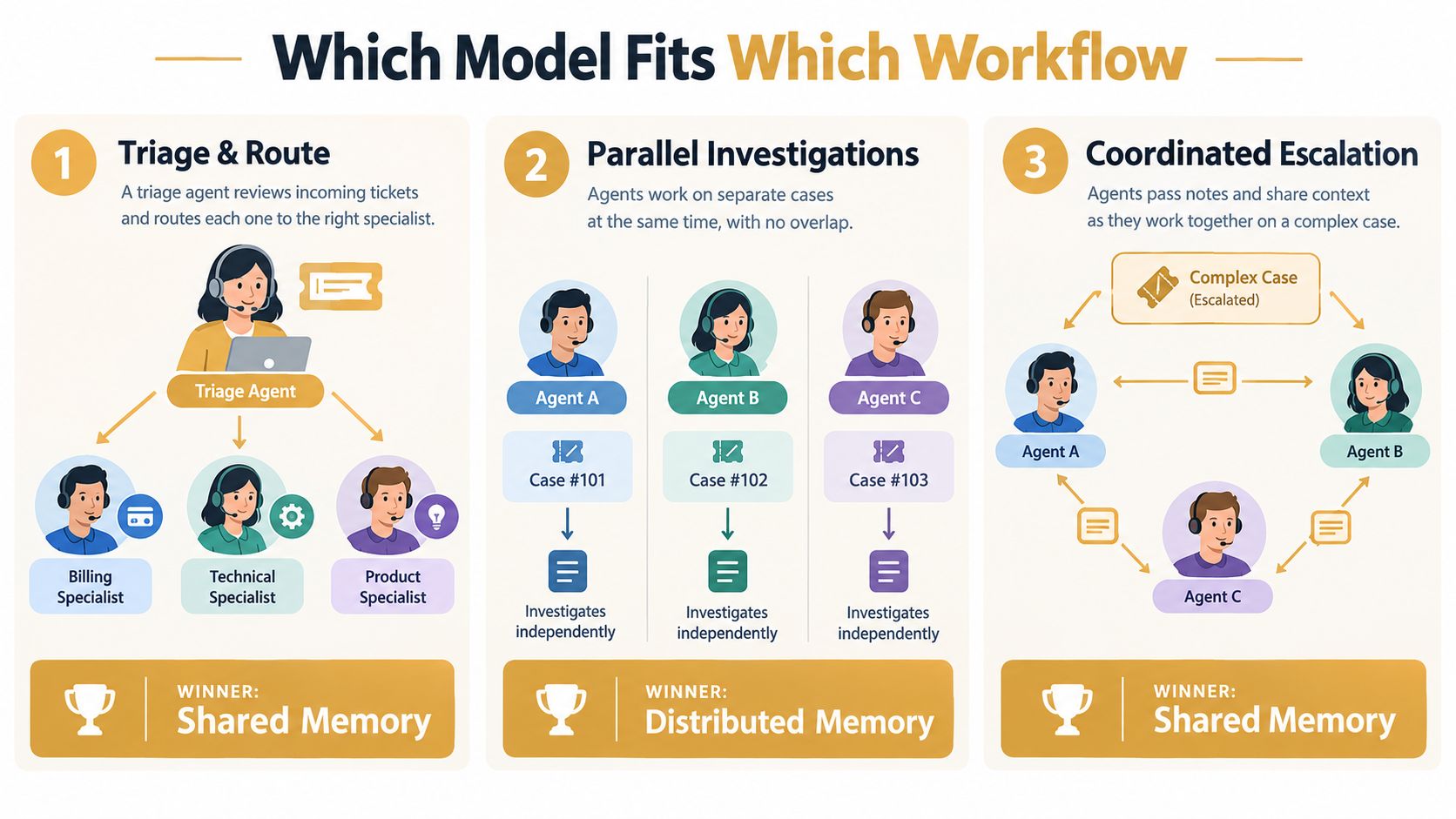
The distributed-memory lecture from TUM makes the same workload-level point. Message passing works poorly when data sharing is frequent, while access patterns with substantial shared data can map naturally to shared memory. Agents need the same discipline: localize independent work, centralize facts that must be jointly understood.
A Practical Decision Rule for Your Fleet
My default for multi-agent coordination is shared persistent memory. The cost of agents disagreeing about a customer, deployment, or task owner is usually higher than the cost of operating a shared memory tier. A common store also removes glue code that teams otherwise build in queues, handoff documents, locks, reconciliation jobs, and repeated prompt instructions.
Start with a shared namespace for facts that multiple agents need during one workflow:
Customer state: Store preferences, approvals, prior offers, and escalation status in one controlled record.
Workflow state: Keep ownership, task status, and completed actions visible to every authorized worker.
Agent-local scratch: Keep temporary reasoning, intermediate retrieval results, and disposable working notes outside the shared namespace.
Write authority: Define which agent may update each field, and reject writes that don't carry enough provenance to audit.
Flip the default when isolation or contention becomes a measured requirement, not a theoretical concern.
Graduate to per-agent or per-tenant distributed stores when one of three triggers appears:
Hard isolation: Regulatory, contractual, or data-residency rules require separate storage boundaries.
Hot-key contention: A measurable write bottleneck shows that one shared record or namespace is throttling the fleet.
Tail-latency failure: Remote-hop variance in the shared tier prevents the request path from meeting its latency objective.
Replication deserves equal discipline. Replicate only the keys whose staleness would cause a customer-visible bug, assign an explicit TTL, and record the source and timestamp. Replication is a consistency mechanism with storage and coordination costs, not a free backup strategy.
The exact moment to change the default is clear: the first time one agent's behavior depends on state produced by another agent in the same request path. Before that point, distributed local state is often simpler. After it, shared persistent memory usually removes more risk and code than it adds.
Use a hybrid hierarchy rather than forcing every byte into one model. Keep hot, ephemeral context local. Put committed cross-agent facts in shared persistent memory. Keep tenant-specific or regulated records in isolated stores, and publish only the minimum aggregate data needed elsewhere.
Applying This on Managed Platforms Like Sokko
A managed platform changes the engineering calculation because the memory layer becomes a fleet capability instead of another service your team has to assemble. On Sokko, shared persistent memory is an optional $25 per month add-on, with 5 GB included and additional storage priced at $3 per GB, as described in the platform information provided for this guide.
That add-on buys a durable store that agents can use across conversations, sessions, and restarts. It also supports organization-level sharing, so multiple hosted agents can read and update common facts rather than passing context through brittle messages or manually copied Markdown. Namespace-scoped permissions, snapshotting, and a single shared location change the operational burden, especially when the alternative is wiring separate Postgres instances, credentials, backups, and reconciliation logic for each agent.
The Sokko memory documentation is the place to verify the implementation details before rollout. Treat the shared namespace as a controlled data product. Separate stable facts from temporary notes, define write ownership, and make sensitive tenant data unavailable to agents that don't need it.
Distributed memory still has a place on the same platform. For regulated workloads, use an isolated agent or tenant store behind a dedicated endpoint. For GPU-heavy jobs, keep scratch state close to the worker and publish only the final artifact. Managed hosting doesn't eliminate architectural trade-offs. It lets you choose isolation without rebuilding the entire runtime and deployment stack.
Run this checklist this week:
Audit handoffs: Find agents that exchange context through copied prompts, Slack messages, or fragile files.
Choose one namespace: Move one shared customer or workflow record into a controlled persistent store.
Isolate one boundary: Identify a tenant or regulated workflow that must never share writable memory.
Measure the path: Capture local reads, shared reads, shared writes, and tail latency before changing the design.
Review authority: Record which agent can create, update, approve, or invalidate each shared fact.
The platform choice should follow the coordination pattern. Shared memory is the sensible starting point for agents that collaborate on one outcome. Distributed memory is the deliberate upgrade when isolation, local performance, or blast-radius control matters more than immediate coherence.
Sokko provides managed, always-on hosting for agent runtimes with optional shared persistent memory, isolated machines, live terminals, and devboxes that turn branches into clickable previews. Visit Sokko to run your fleet with shared coordination where it helps and isolated memory where the workload demands it.