
You've deployed an AI agent to handle customer support for people in the European Union. The prompts contain personal information, the agent stores conversation memory, and every response creates an audit record. The system appears to work perfectly until someone checks the infrastructure and discovers that inference logs are being routed through a United States region because the default cloud configuration selected the lowest-cost path.
That discovery changes the engineering question. It is no longer about where the application is hosted. The questions now are where every prompt, embedding, model snapshot, backup, log, and administrator action go. Sovereign AI cloud exists to answer those questions with enforceable technical, legal, and operational controls.
Table of Contents
<a id="the-moment-sovereign-ai-cloud-stops-being-abstract"></a>
The Moment Sovereign AI Cloud Stops Being Abstract
The first problem usually appears during a compliance review, not during deployment. A team knows that its main database sits in an EU region, so it assumes the AI workload is European. Then an engineer traces the request path and finds that the model endpoint, telemetry service, support tooling, or log archive operates elsewhere.
The consequences can arrive quickly:
GDPR exposure: Customer prompts may contain names, account details, or sensitive support information that crosses a jurisdiction the organization never approved.
Broken audit trails: Compliance staff can't reliably prove where an inference happened, which administrator accessed the environment, or where the resulting logs were retained.
Contract review fallout: A customer or public-sector buyer may reject the architecture because the provider's legal entity, support personnel, or subprocessors remain outside the required jurisdiction.
The issue isn't that an international cloud provider is automatically unsafe. The issue is that a regional selection often answers only one narrow question: where a particular service stores or processes some data. It may not answer where control-plane metadata, backups, model artifacts, support access, or derived data travels.
Practical rule: Treat every AI dependency as part of the data path, including memory stores, vector databases, observability systems, model gateways, and human support access.
Sovereignty becomes concrete when a team has to document those paths. The architecture must identify where the prompt enters the system, where the model runs, where the agent retrieves context, where it stores memory, and where operators can intervene. Each path needs a policy that can be tested rather than a product label that sounds reassuring.
That's why sovereign AI cloud is best understood as an engineering response to jurisdictional uncertainty. It combines regional placement with control over infrastructure, administration, legal exposure, and AI-specific artifacts. The objective isn't to make a political statement about cloud providers. It's to make the runtime behavior match the organization's obligations.
<a id="what-a-sovereign-ai-cloud-actually-is"></a>
What a Sovereign AI Cloud Actually Is
A useful definition starts with a control gradient. A generic regional cloud keeps selected data in a geographic region, but the provider may still operate the control plane globally, retain administrative access, or route telemetry through another location. A national cloud adds a local operator and stronger jurisdictional alignment. A sovereign cloud adds enforceable legal and operational control. A sovereign AI cloud applies those protections to the complete AI workload, including models, GPUs, inference, training data, memory, and logs.
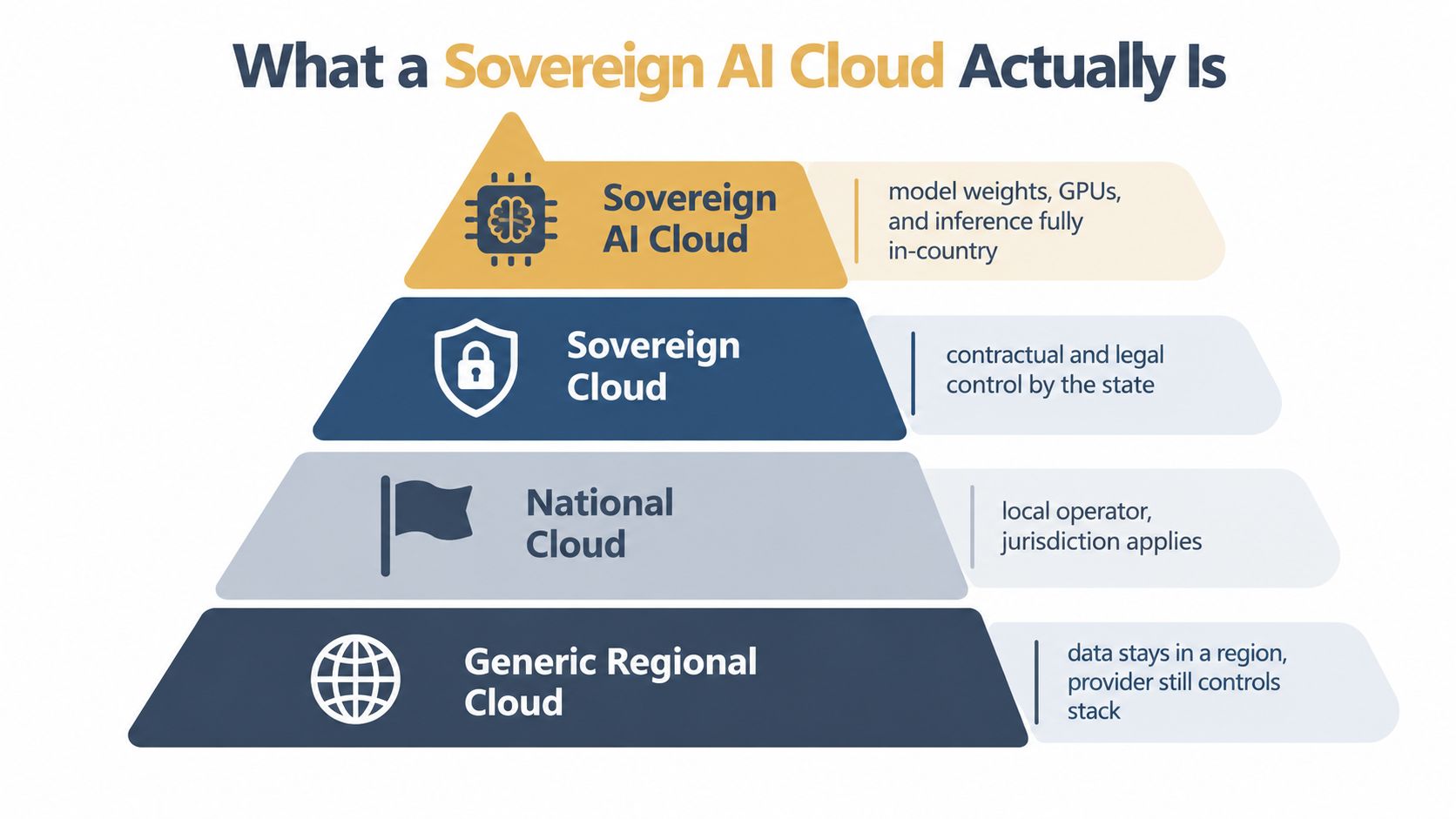
An apartment analogy makes the distinction clearer. Renting an apartment in your country gives you a local address, but the landlord still controls the building and may hold the master key. Owning a deeded property gives you stronger control over access and use, although local law still applies. Living in a self-governed enclave adds dedicated administration, clearly defined authority, and separate operating rules.
Cloud sovereignty follows a similar progression:
Location: Data and compute remain in an approved geography.
Jurisdiction: The legal entities, contracts, and access rules align with that geography.
Operations: Local personnel or dedicated operators manage administration, support, keys, and lifecycle actions.
AI execution: Model weights, training inputs, prompts, embeddings, inference results, agent memory, and audit records stay within the approved boundary.
The last layer matters because AI systems create more than a database row. A retrieval-augmented application may generate embeddings and vector indexes from customer documents. An agent may retain long-term memory about users or internal processes. A fine-tuned model may encode confidential business knowledge. An inference log may reveal the original prompt even when the application database contains only a reference.
The IDC sovereign cloud solutions brief describes technical sovereignty as extending to the infrastructure and services used to provision, monitor, and operate workloads. That means a provider should be able to explain how placement policies, administrative controls, performance management, and physical or digital access work in practice.
A provider can host an AI application in the EU without offering full sovereignty. Buyers should ask for evidence across the entire stack, not just a region name. Sovereign AI cloud is a set of verifiable guarantees, not a synonym for EU hosting.
<a id="why-the-category-is-expanding"></a>
Why the category is expanding
The market projections indicate why this distinction has become commercially important. One estimate places the sovereign AI cloud market at USD 111.41 billion in 2025 and projects USD 1,603.43 billion by 2035, implying a 30.58% CAGR. Another view places the sovereign AI cloud segment at USD 149.57 billion in 2025 and forecasts USD 1,567 billion by 2035, with a 26.5% CAGR from 2026 to 2035, as reported in the sovereign AI cloud market analysis.
These are forecasts, not guarantees. They show that buyers increasingly see AI infrastructure and jurisdictional control as one purchasing decision rather than two separate projects.
<a id="the-four-pillars-of-sovereign-ai-cloud"></a>
The Four Pillars of Sovereign AI Cloud
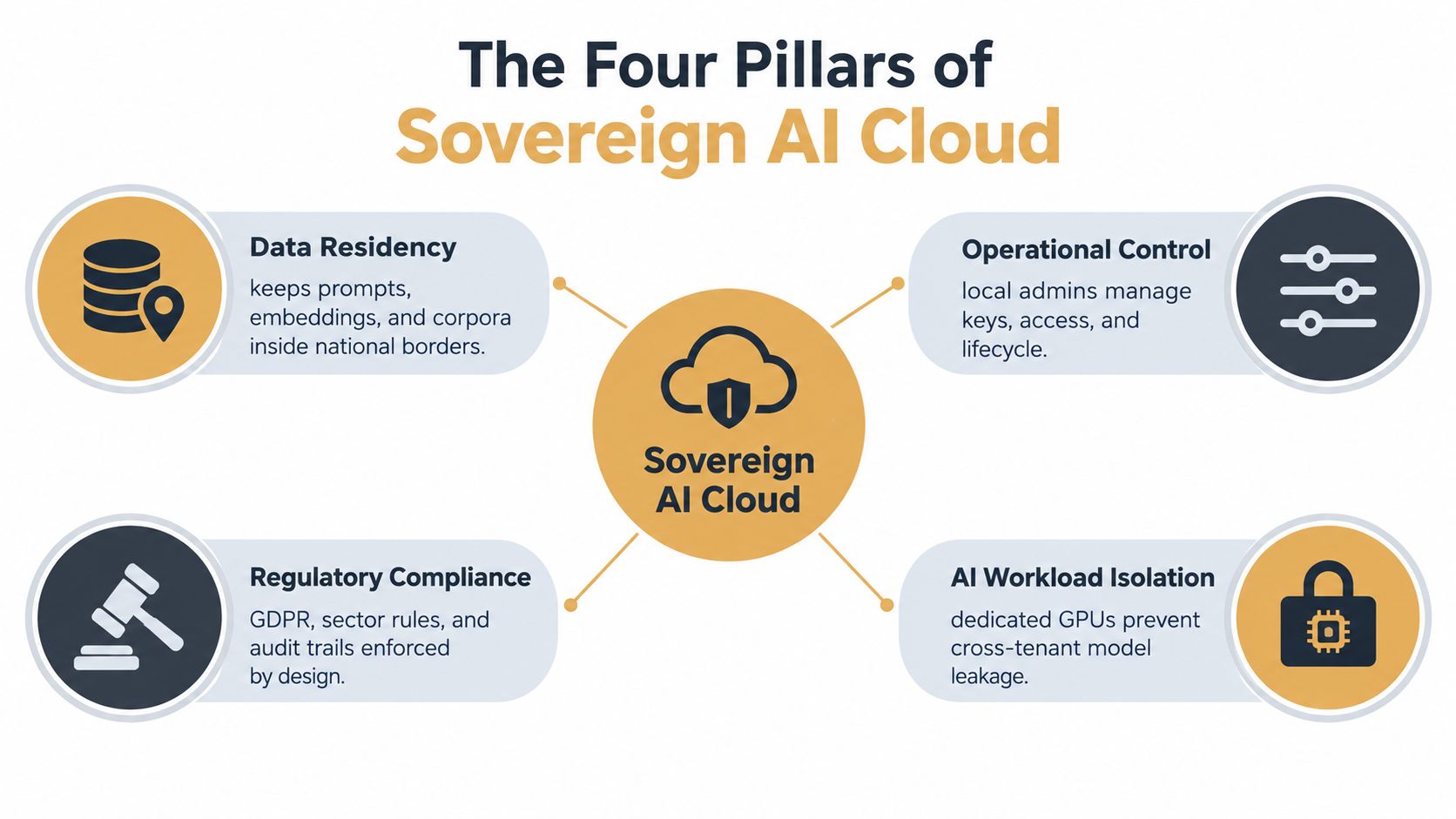
Sovereignty fails when an organization protects only the primary database. AI workloads create multiple copies and transformations, so the architecture needs four connected pillars.
<a id="data-residency"></a>
Data residency
Data residency defines where information is stored and processed. For an AI system, that includes training corpora, prompts, completion outputs, embeddings, vector indexes, model snapshots, backups, logs, and derived analytics.
Suppose an EU retailer stores its source documents in an EU object store but sends the resulting embeddings to a globally managed vector service. The original files may remain in Europe, yet the retrieval layer still contains information derived from those files. A sovereignty review that checks only the source bucket misses the exposure.
<a id="operational-control"></a>
Operational control
Operational control asks who can administer the system and under what conditions. The answer should cover encryption keys, privileged access, support sessions, software updates, incident response, and disaster recovery.
A customer may have local storage while a foreign operator retains the ability to access the host, change routing, or inspect diagnostics. That arrangement may satisfy a basic residency policy but not a requirement for operational independence. The buyer needs auditable records showing which administrators acted, what they could access, and how emergency access is restricted.
European cloud programs demonstrate this broader interpretation. Oracle stated that its EU Sovereign Cloud was being used in 15 countries across Europe and was designed around EU-resident personnel, EU-incorporated legal entities, and data kept entirely within the EU, as described in this overview of the sovereign AI cloud market.
<a id="regulatory-compliance"></a>
Regulatory compliance
Regulatory compliance turns technical properties into documented obligations. GDPR can affect personal data in prompts and logs. The EU AI Act can influence governance, documentation, monitoring, and risk management for applicable AI systems. NIS2 and sector-specific rules can add resilience, security, and incident-reporting expectations.
No cloud architecture automatically makes an organization compliant. Instead, the platform should provide controls that help the compliance team demonstrate how requirements are implemented. A useful guide to EU residency requirements should lead to concrete questions about storage, processing, support access, and subprocessors.
<a id="ai-workload-isolation"></a>
AI workload isolation
AI workload isolation protects the execution environment itself. Shared infrastructure may be appropriate for low-risk applications, but regulated inference and confidential model training can require dedicated or logically separated networks, GPUs, storage, and control planes.
Isolation also applies to model artifacts. A model snapshot, fine-tuning dataset, or agent memory store may be as sensitive as the original data. The Oracle sovereign AI brief describes architectures that are physically, logically, and cryptographically separated from public regions, including disconnected environments for particularly sensitive workloads.
<iframe width="100%" style="aspect-ratio: 16 / 9;" src="https://www.youtube.com/embed/Ve3Gu9cmbvk" frameborder="0" allow="autoplay; encrypted-media" allowfullscreen></iframe>These pillars reinforce one another. Local storage without local administration leaves an access gap. Local administration without isolated inference leaves an execution gap. Isolated compute without reliable audit logs leaves an assurance gap.
<a id="sovereign-ai-cloud-vs-public-cloud"></a>
Sovereign AI Cloud vs Public Cloud
Public cloud and sovereign AI cloud aren't opposite categories in every case. A hyperscaler may offer strong regional controls, while a sovereign provider may use familiar public-cloud technology underneath. The important comparison concerns the guarantees attached to a particular workload.
| Dimension | Sovereign AI Cloud | Public Cloud |
|---|---|---|
| Data residency | Designed to keep approved data, artifacts, and processing inside a defined jurisdiction | Often offers region selection, but coverage varies by service and artifact |
| Jurisdictional exposure | Contracts, operators, legal entities, and access policies align with the required jurisdiction | The provider may remain subject to foreign law or global operating procedures |
| Model and prompt control | Gives explicit control over model weights, prompts, memory, embeddings, and inference paths | Controls depend on the service, model provider, region, and configuration |
| Audit transparency | Emphasizes demonstrable operator access, placement, and lifecycle records | Audit tools may be extensive, but global dependencies can complicate interpretation |
| Vendor lock-in | May narrow the available ecosystem or use specialized interfaces | Usually offers broad managed services and model choices |
| Regional latency | Can provide a predictable path to approved users and systems | May be fast in-region, but supporting services can introduce extra hops |
| Cost | May cost more because of dedicated infrastructure and restricted operations | Often provides broader pricing options and greater elasticity |
A public-cloud region is therefore a useful building block, not proof of sovereignty. A model endpoint might process data in one country while the provider stores monitoring data elsewhere. A managed key service might use a different administrative boundary. A support engineer might access the environment through a global operations system.
The opposite mistake is assuming that sovereign infrastructure is always faster, cheaper, or more capable. Dedicated controls can reduce flexibility, limit access to some frontier models, and require more careful capacity planning. The trade is jurisdictional certainty for some ecosystem breadth and operational convenience.
Teams should also examine the exact path rather than compare brands. A public cloud may be suitable for public documentation generation, development environments, and non-sensitive classification. A sovereign environment may be necessary for an agent that handles regulated records, stores sensitive memory, or takes compliance-bound actions.
A practical explanation of EU GDPR requirements can help teams translate legal concerns into technical review questions. The goal isn't to place every workload under maximum restriction. It's to identify which constraint actually binds the workload.
<a id="migration-patterns-and-architecture-choices"></a>
Migration Patterns and Architecture Choices
Migration starts with classification, not infrastructure procurement. List the information that enters the AI system, the artifacts it creates, and the services that can access them. Include prompt text, uploaded files, retrieval indexes, agent memory, model outputs, logs, backups, and support tooling.
A simple inventory can divide workloads into three paths:
Public path: Public documents, synthetic data, development experiments, and non-sensitive inference.
Guarded path: Personal data, internal business information, regulated-sector records, and models that require local key custody.
Maximum-control path: Classified information, critical infrastructure systems, trade secrets, or agents that can perform high-impact actions.
<a id="pin-the-complete-inference-path"></a>
Pin the complete inference path
Region-pinning the model server isn't enough if the application sends prompts through a global gateway. Route the application, model endpoint, retrieval store, memory service, and audit pipeline through the same approved boundary where the workload requires it.
An EU-only vector store is one concrete pattern. Another is region-locked model serving, where the scheduler refuses to place sensitive containers outside approved zones. For high-sensitivity systems, separate training and inference networks can prevent operational tooling from becoming an unexamined route out of the environment.
<a id="keep-keys-and-evidence-local"></a>
Keep keys and evidence local
Customer-managed encryption keys can give the organization stronger control over data access, but the key service itself must fit the sovereignty requirement. The same applies to audit logging. Logs should record inference requests, administrator actions, policy decisions, and data movement in a system that compliance staff can inspect and retain under the relevant jurisdiction.
A common failure occurs when engineers pin the database but leave telemetry on the provider's default global service. Another occurs when backups replicate automatically to a location that the application team never reviewed. Teams evaluating physical placement should also account for facility, network, power, and operator considerations in their data center selection process.
<a id="use-a-hybrid-topology-deliberately"></a>
Use a hybrid topology deliberately
Hybrid design can be more defensible than forcing every component into the same environment. A team might keep public documentation generation and model experimentation on a general cloud platform while sending regulated customer-support inference and agent memory to sovereign infrastructure.
The routing policy must be explicit. It should classify the request before inference, prevent sensitive data from entering an unapproved model, and preserve an audit record explaining the decision. This creates a controllable boundary rather than an informal promise that developers will remember which endpoint to use.
<a id="why-full-sovereignty-is-usually-overkill"></a>
Why Full Sovereignty Is Usually Overkill
Maximum sovereignty carries real operational costs. Dedicated infrastructure can reduce model choice, increase procurement friction, complicate scaling, and slow experimentation. Those costs are justified when the workload has serious residency, legal, or operational exposure. They're wasteful when the agent processes information that anyone can already access.
A marketing assistant generating copy from a public product page doesn't need the same controls as an agent reviewing medical records. A development chatbot working from synthetic tickets doesn't need the same isolation as an operational agent that can change production systems. The architecture should reflect the potential harm, not the emotional intensity of the word “AI.”
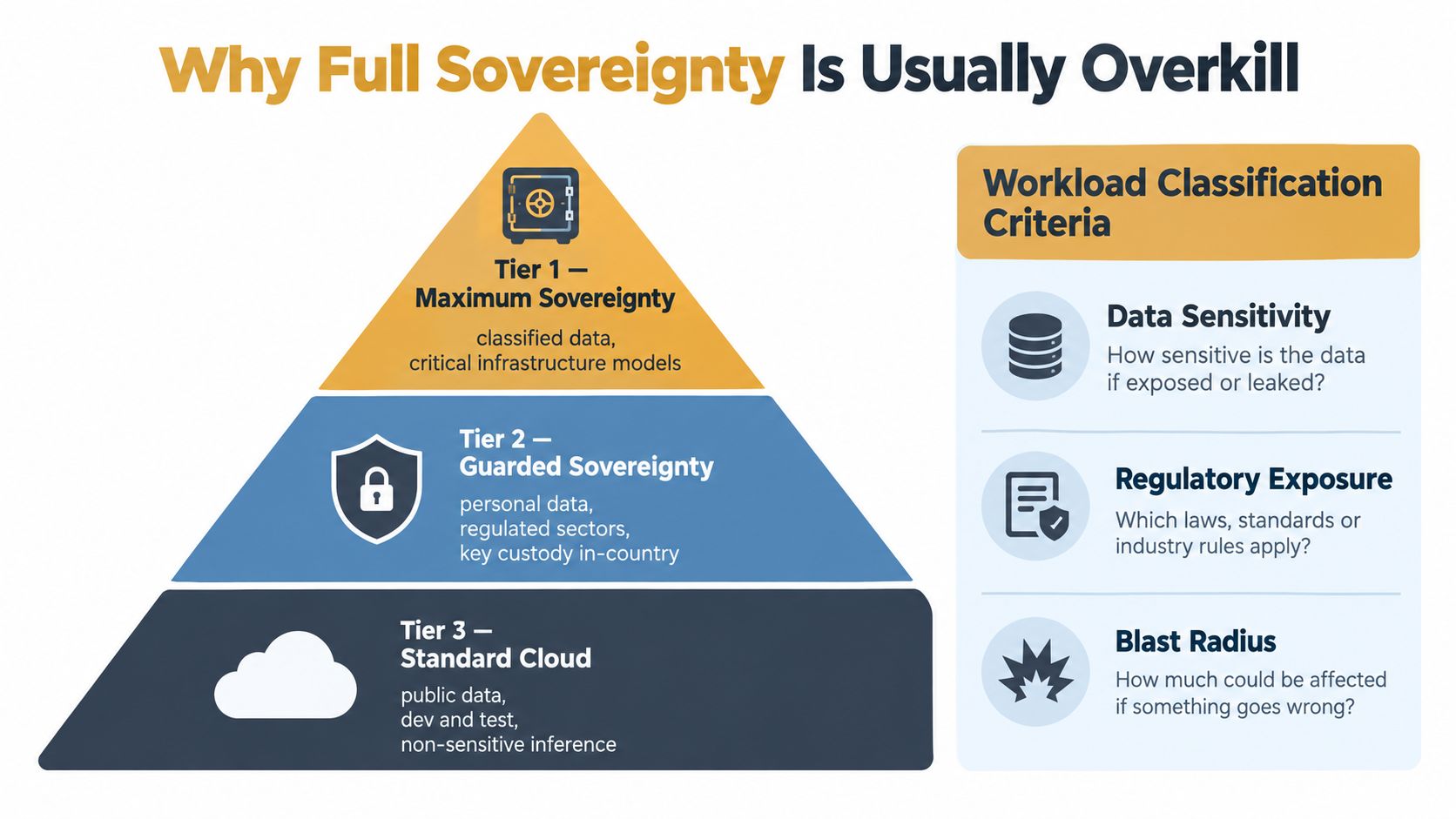
The classification decision can use three questions:
Data sensitivity: Would exposure of the prompt, memory, training data, or output cause privacy, commercial, or security harm?
Regulatory exposure: Does the workload fall under residency, sector, procurement, or AI governance requirements?
Blast radius: What could happen if the model leaks information, produces an incorrect result, or takes an unauthorized action?
A useful mapping looks like this:
Tier 1, maximum sovereignty: Classified data, critical infrastructure models, confidential model weights, and high-impact agent actions. Use dedicated or strongly isolated infrastructure, local keys, strict operator controls, and full audit evidence.
Tier 2, guarded sovereignty: Personal data, regulated-sector workloads, and internal information that requires regional processing. Use approved-region inference, local memory and vector stores, controlled administration, and verified logging.
Tier 3, standard cloud: Public data, development and test environments, marketing content, and non-sensitive inference. Use ordinary cloud controls and keep the architecture simple.
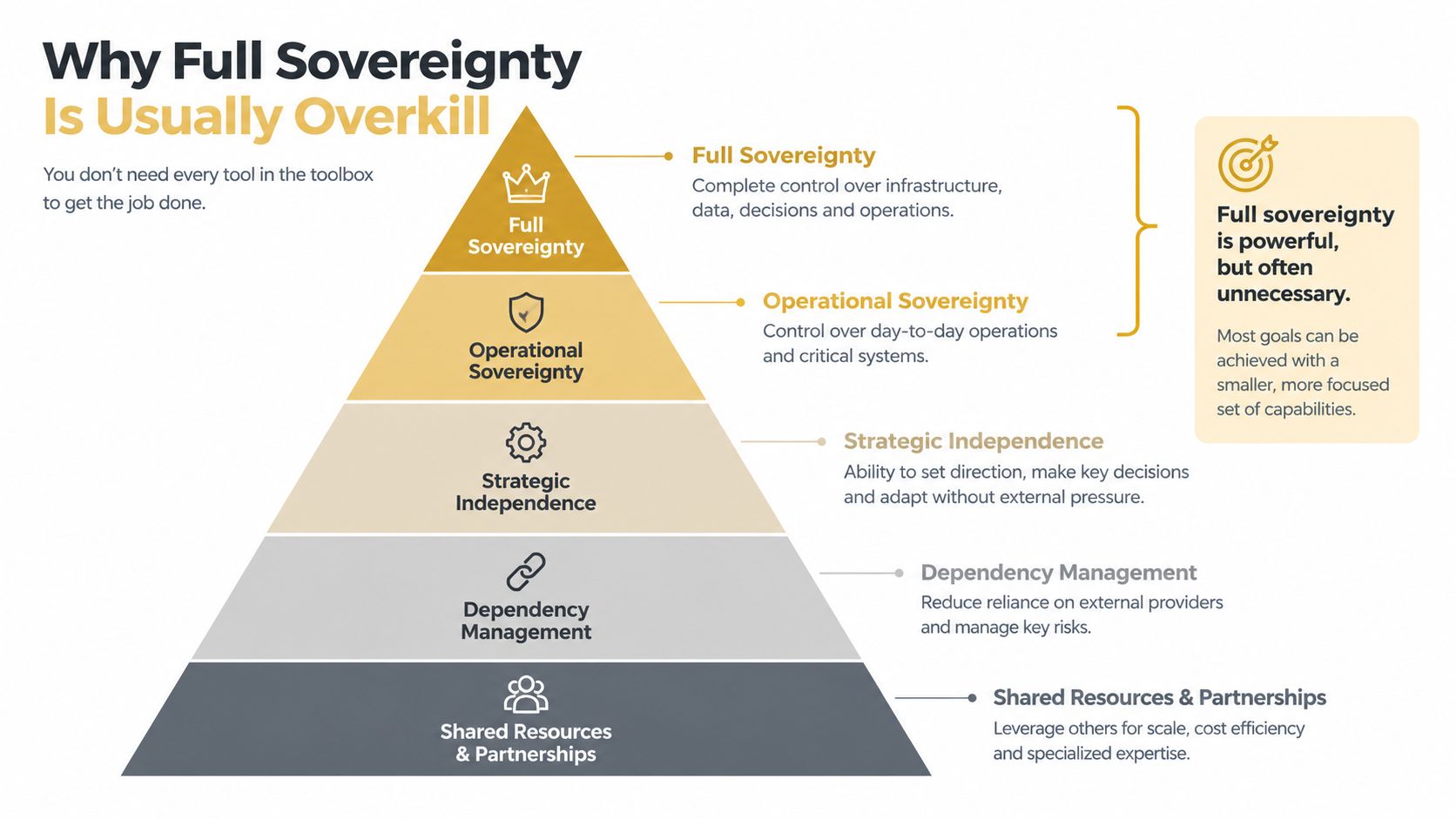
This selective approach has support in recent market guidance. An Accenture 2025 survey found that companies could capture sovereign opportunities by applying sovereignty measures to one-third of AI initiatives, rather than treating every initiative as fully sovereign, as summarized in Microsoft's guidance on sovereignty for AI workloads.
That doesn't make partial sovereignty a shortcut. It makes it a risk-management decision. Teams should document why a workload belongs in a tier, which paths require control, and what would trigger reclassification.
<a id="sokko-and-sovereign-ai-cloud-in-practice"></a>
Sokko and Sovereign AI Cloud in Practice
Consider an engineering team hosting an always-on agent that handles EU customer requests and creates code changes. The team needs more than a machine in a European data center. It needs a defined location for the agent's persistent files, memory, prompts, inference traffic, logs, and connected application data.
Sokko provides managed hosting for AI agents on isolated cloud machines, with US and EU regional options. For eligible configurations, EU data residency and EU-hosted inference options allow a team to keep storage, shared memory, and model execution aligned with an EU deployment boundary.
The runtime decision can be expressed in operational terms:
At rest: Agent files and persistent memory use the selected EU region rather than a globally replicated default.
In transit: The application routes requests to an EU-hosted inference option when the configuration requires regional processing.
During execution: Each hosted agent runs on its own isolated machine, which separates its runtime from neighboring agents.
For inspection: The web console, live terminal, logs, and readable Markdown configuration give developers visibility into the running environment.
For access: Teams can use private networking with Tailscale or Cloudflare Tunnel, and devboxes can run in a private Tailscale mode without a public URL.
The same model applies to a development workflow. A devbox runs one repository's full stack, including its application, databases, and queues, behind a real preview URL. A team can keep a sensitive branch inside its selected environment, test the result in a browser, and inspect the machine without handing infrastructure administration to every developer.
This doesn't eliminate the customer's responsibilities. The team still needs to classify prompts, choose approved model keys, review connected apps, define retention, and verify which logs contain personal information. A regional hosting option is a runtime control, not a complete compliance certification.
The practical value is that sovereignty becomes a deployment choice. The team can decide that public documentation generation uses a standard path, while customer-support memory, regulated prompts, and audit records use the EU path. That is the difference between a blanket policy and a workload-aware architecture.
<a id="choosing-your-sovereign-ai-cloud-starting-point"></a>
Choosing Your Sovereign AI Cloud Starting Point
Start with an inventory of current AI workloads. For each one, record the data entering the system, the model endpoint, the memory and retrieval services, the audit pipeline, administrator access, backups, and external integrations.
Then ask four specific questions:
Inference: Must the prompt and model response remain in a particular jurisdiction?
Memory: Do embeddings, vector indexes, agent memory, or model snapshots contain regulated or confidential information?
Audit: Where are logs stored, who can read them, and can the organization prove where an action occurred?
Operations: Who controls keys, support access, placement policies, updates, and recovery?
Shortlist providers that can demonstrate region pinning, contractual data-location guarantees, operator-access controls, and transparent audit records. Don't accept “sovereign” as an answer by itself. Ask what stays in the jurisdiction, what leaves it, who can access it, and which services are excluded from the guarantee.
A sensible starting sequence is to audit the existing workloads, score each by residency risk and blast radius, prototype the highest-risk path in a sovereign-anchored environment, and expand only when compliance pressure or observed bottlenecks justify it.
Sokko offers EU-region hosting for always-on AI agents, isolated machines, persistent memory, private access, and EU-hosted inference options for eligible configurations. Visit Sokko to evaluate a regional agent deployment around the specific inference, memory, and audit paths your team needs to control.